Showing posts with label Vincent Price. Show all posts

Saturday, July 4, 2026

Return of the Fly (1959)

Our sequel today picks up fifteen years after the events of its originator at the graveside service of Helene Delambre, who never really recovered after assisting her husband Andre’s suicide.

You remember, right? When the mad scientist placed his head and hand into a hydraulic press after his experiments in matter teleportation went staggeringly awry, where his atoms were mixed with a fly, turning Andre into a fly-headed, fly-handed monster? Right? Right. If not, go watch The Fly (1958) and then come back. Go on. We can wait -- just remember where you left off.

For the record, only Helene, the deceased's brother, Francois (Price), and Chief Inspector Charas knew the real truth, about the mutation, with Charas being responsible for the murder of the other half of this failed experiment, trapped in a spider’s web, crushing the pitiful, pleading creature with a rock before a spider pounced.

But now, their orphaned son, Philippe (Halsey), demands to know the truth as to what really happened to his father, which haunted his mother so badly all these years that it eventually drove the woman to an early grave. And once his uncle finally spills the beans, Philippe is soon determined to perfect his father’s teleportation machine and secure his family's legacy.

At first, Francois wants no part of this but soon comes around -- mostly to make sure Philippe doesn’t make the same critical mistakes his father had.

Moving all the machinery to the basement of the old ancestral mansion, using his father’s notes, Philippe, Francois, and Philipe’s assistant, Ronald Holmes (Frankham), soon have the transporter rebuilt and fired-up and successfully disintegrate and reintegrate several varmints.

Too bad for all involved that Holmes is acting under an alias, is a wanted man for murder, and is currently engaging in some industrial espionage. And after his assistant uses the contraption to destroy the body of one of Scotland Yard’s finest, Philippe sniffs out his true intentions before the villain can cash-out.

Unfortunately for Philippe, this confrontation does not go his way at all and he winds up in the transporter, too.

Also, Holmes tosses a fly in there with him because, one, his former boss suffers from a severe case of pteronarcophobia; and two, he’s seen what the transporter can do when two different test-subjects get zapped at the same time (-- that aforementioned cop and a hamster); and three, he’s just that big of an asshole.

Alas, Francois arrives too late to stop any of this and winds up taking a bullet while Holmes escapes; but he does manage to trip the switches for the reintegration process, and then Francois comes face to face with his worst nightmare come true... 

After squandering a shit-ton of money converting their projection booths to accommodate 3D stereoscopic films, a fad that had barely lasted six months, most theater owners were either skeptical or downright hostile when Darryl F. Zanuck asked them to now tear all of that out and widen their screens instead for his newly minted CinemaScope process in late 1953.

However, having learned a harsh lesson over the non-standardization of the 3D free-for-all, Zanuck promised more consistency to appease exhibitors, promising a steady supply of product in this new widescreen format.

The Grand Island Independent (December 31, 1953). 

To do this, Zanuck and 20th Century Fox struck a deal to make the lenses and equipment for CinemaScope readily available to other studios; and Fox even went so far as to bring in Robert L. Lippert to produce a series of B-Pictures shot in the same widescreen process.

And so, together, they formed Regal Pictures in 1956, which landed Lippert a seven year commission to make 20-pictures per year, each shot in seven to ten days, with a budget of $100,000. Though one should note that Zanuck hedged the deal, not allowing his new B-Unit to smirch the reputation of his A-product, which is why things like Stagecoach to Fury (1956), Kronos (1957), and Hell on Devil’s Island (1957) were all technically shot in 'Regalscope.'

The Grand Island Independent (July 18, 1957). 

Fox and Zanuck never were ones for genre pictures and seldom dabbled in horror and sci-fi -- the only real monster movie I can think of was The Undying Monster (1942), which was pretty great if you've never seen it, which makes their production of The Fly a bit of an anomaly; especially after the big-budgeted sci-fi epics This Island Earth (1955) and Forbidden Planet (1956) both disappointed at the box-office for rival studios Universal and MGM respectively.

But even though The Fly was shot in CinemaScope and Technicolor, the production cost was kept fairly low, around $350,000, when compared to $800,000 for This Island Earth and $1,900,000 for Forbidden Planet. But unlike those other two films, The Fly proved to be a huge hit for Fox and became one of its biggest money-makers of '58. And technically, it wasn’t really a Fox product at all -- at least not at first.

The Fly was an in-house project,” said Bernard Glasser in an interview with Tom Weaver (Science Fiction Stars and Horror Heroes, 1991). Glasser was one of Lippert’s stable of producers, who revealed, “Regal purchased the short story by George Langelaan that appeared in Playboy Magazine. Lippert felt that he had something special with this project, and he requested additional funds to produce the picture.”

And so, The Fly would essentially get an upgrade and nearly all traces of its Regal origins were systematically removed. Said Glasser, “If Lippert relinquished producer credit, it must have been for a good reason; I’m sure that he could’ve had producer credit if he felt it was important.”

And perhaps slightly embarrassed by its subject matter despite the box-office success, but not embarrassed enough to not cash-in, when a sequel proved to be in order, the studio quickly distanced itself and turned the franchise back over to Lippert.

By 1959, Lippert had dumped the Regal moniker and rechristened his unit as Associated Producers Incorporated (API). And to pull off this mandated sequel, Return of the Fly (1959), he turned to Glasser and director Edward Bernds -- the two men who had produced Space Master X-7 (1958) for him, which had served as the equally successful bottom-bill for The Fly.

The Fly was the sleeper hit everyone had hoped it would be,” said Glasser. “It was Harry Spalding’s idea to make a sequel. (Spalding was Lippert’s production supervisor.) He suggested that Ed and I be given the project.”

“Why we got Return of the Fly I don’t know,” Bernds explained to Weaver (Interviews with B Science Fiction and Horror Moviemakers, 1988). “Maybe Fox thought it was going to be a slough-off, just something to cash-in on the popularity of the first one. But I also think it was kind of a bad time for Fox and they thought they could capitalize on us, at a reasonable cost, and get a reasonable product.”

I delved into the cinematic history of Glasser and Bernds when I wrote up Space Master X-7 a while back, so feel free to check that out to get up to speed on them. But as they set to work on the sequel, it turns out the parent studio wasn’t quite ready to let go of the project after all -- at least not completely.

Return of the Fly was supposed to be just another Regal project,” said Glasser (Weaver, 1991). “Perhaps it was the quality of Ed’s script or revised thinking on Lippert’s part that upgraded the project".

To start, the production was under orders to use the still standing sets from the first film to help save even more costs, meaning it would be another rare feat for Lippert’s B-unit, where it would be allowed to actually shoot on Fox’s backlot, which had been strictly forbidden.

Said Bernds (Weaver, 1988), “We who worked for Lippert were kind of second class citizens as far as Fox was concerned -- pariahs, so to speak. Fox didn’t want us on the deluxe Westwood lot, but when the time came to do Return of the Fly they wanted us there.

The San Francisco Chronicle (August 3, 1959). 

“I believe this was a tough period for Fox and they wanted us to absorb some of their overhead," Bernds continued. "Return of the Fly was made at the Fox Westwood lot, with Fox personnel all the way through, even a cameraman. Fox just simply couldn’t do things in any way except top-notch, and so our sets for Return of the Fly were as good as an A picture’s would be.”

Thus, the sequel would be shot officially in CinemaScope but would be demoted to black and white film stock -- just like its co-feature, Roy Del Ruth's The Alligator People (1959), whose title pretty much says it all. 

The Los Angeles Times (August 26, 1959). 

Added Glasser (Weaver, 1991), “Most of our money was being spent unproductively … The production department of the Fox studio asked Lippert to move Return of the Fly to the studio instead of our shooting it at an independent lot. Of course this means an increase in production costs and no control. Because of the inefficiency of the slower Fox crews and the added charges and surcharges for set operation and construction, it was impossible for me to lock in any expenditures. I had been reluctant to make the move to Fox and had predicted problems. But Lippert didn’t want to antagonize the Fox big brass. But shooting on the Fox lot greatly enhanced the production values of the picture.”

Still, despite the upgrade, Bernds felt the shoot was plagued with bad vibes. “It seems to me that the 20th Century lot was a rather dismal place when we shot Return of the Fly there. Not much (other) production, and many of the crew worried about their jobs.”

Meanwhile, as Bernds hammered out the script, it would prove interesting enough to coax Vincent Price back into the fold to reprise his role as Francois. “He wouldn’t sign to do the film until he read the script,” said Bernds (Weaver, 1988). “So, as soon as I had a first draft I sent it to him. Then, after he’d read it, I visited him in his palatial home -- that’s a fancy word, but believe me, his place was palatial -- and he said he liked the script. We discussed it at considerable length, he said he’d sign and he did.”

“We were surprised when Lippert approved Price and his salary,” said Glasser (Weaver, 1991). “Perhaps Price had been a good luck omen for Lippert. It began with Price appearing in Lippert’s The Baron of Arizona (1950). Or perhaps Lippert was playing on a hunch. At any rate he approved the additional expenditure for Price, $25,000. (The total budget was estimated around $275,000.) Price was always a gentleman, always ready and prepared, but as I recall he was not overly enthusiastic about the screenplay!”

Yeah, unfortunately, most of those “interesting” moments Price signed-up for wound up cut-out completely, much to the star’s chagrin.

Said Bernds (Weaver, 1988), “What Vincent read was a first draft, and like many first drafts it was a little overlong, and some cuts were made to trim it down and some changes made to bring about budget economies. Vincent liked some of the scenes we had cut, and he objected.

“If I recall correctly, they were mostly scenes with Danielle De Metz -- scenes of warmth and charm, but, when you’re pressed for footage, not truly essential to the progression of the story. But I conferred with Vincent from time to time, and I made changes that satisfied him.”

Thus, despite these changes, Bernds found Price a delight to work with, calling him “thoroughly professional, always prepared, giving his best to every scene. His wasn’t even the biggest part in Return of the Fly, but his star status and the strength he brought to his performance lifted it out of the B-category it might have fallen into."

As for the main protagonist, Glasser cast Brett Halsey. Now, Halsey seemed to be cursed with bad timing throughout his Hollywood career. He got signed at Universal but barely made a scratch -- though some folks might recognize him as one of the two teens who get killed in Revenge of the Creature (1955), the one who wasn't fastballed into a tree -- before the studio was bought out by MCA, which cut staff and purged all contract players in 1958.

But the actor landed on his feet at American International, where Halsey headlined the likes of High School Hellcats (1958), also directed by Bernds, and Submarine Seahawk (1959). And then, after starring in Return of the Fly, he got signed by Fox to a multi-year contract. But then this was voided, too, after the whole Cleopatra (1963) debacle, which nearly bankrupted the studio.

Halsey would have much better luck abroad, working with the likes of Mario Bava and Lucio Fulci in Italy. And while Halsey does fine as Philippe, he really isn’t in the film all that much. I swear, his pasted-on head on the tiny fly almost had as much screen-time as the real actor did.

“The whole cast was good to work with -- Halsey was excellent, as always,” recalled Bernds (Weaver, 1988). “David Franklin, who played the villain, was new to me … I wanted the contrast between the charming and pleasant Alan and the killer Alan to be a startling one, and David was everything I’d hoped for when I wrote his scenes. De Metz was very young, very pretty; practically no experience, but her youth and beauty were a plus. Maybe the fact that she wasn’t an experienced actor made her performance seem more innocent and more real.”

The only disappointment Bernds had with the cast was a failure to sign on Herbert Marshall to return as Inspector Charas. “I must have written with Marshall in mind because the role in my script is referred to as Charas throughout -- but in the movie the character played by John Sutton was named Inspector Beachum. I’m not sure why we didn’t get Marshall, but he would’ve added stature to the part, and another link to the first Fly would have been a definite plus.”

The last notable cast member was Ed Wolff, a former circus giant, who had portrayed Bela Lugosi's robot in The Phantom Creeps (1939), a Martian in Invaders from Mars (1953), and the rampaging cyborg in The Colossus of New York (1958). Wolff took over the role of Philippe after his transformation into a human-fly hybrid. Then, as the creature breaks out of the lab, is merrily chased around the hills by the cops for a spell, it then spends the rest of the movie tracking down and killing those who double-crossed him.


Ed Wolff (right), The Colossus of New York

All the while, Francois, the Inspector (Sutton), and Phillipe's long-suffering girlfriend, Cecilia (De Metz), manage to capture the Fly Human and hope the Human Fly can be herded back to the lab and into the transmitter where they think they can, hopefully, reverse the process.

“I believe that what the science fiction writer needs most is a sense of story and enough science to make it work,” said Bernds (Weaver, 1988). But the writer / director also freely admitted that most of his films in the genre were “utterly unscientific and that ridiculous was probably not too strong a word” to describe them, and how “science really takes a beating in his pictures.” But they still entertained people and made money.

Glasser and Bernds had wanted to insert footage from The Fly to pad out the sequel and fill-in the backstory; but Fox nixed this, feeling the color footage wouldn’t mesh with the rest of the film properly. This left it to Price to get us all up to speed with a massive plot-dump at the beginning of the film.

Now, I had never seen this sequel before writing it up, but judging from all the photos and stills I had seen over the years I felt the monster design and mask for Return of the Fly looked so much better than the original. And while I still think it looks better in theory, in action -- oh, great googly-moogly.

It's so huge the poor stuntman ensconced inside it can barely keep his balance as he runs around. I mean, watch as Wolff keeps reaching for it, to steady it, as the encephalitic contraption constantly wobbles and teeters around and threatens to topple him. (Ironically enough, my problem with the original was I thought it was too small?!)

“[Wolff] just couldn’t stand on his feet for long periods of time,” said Glasser (Weaver, 1991). “And he had great difficulty breathing while wearing the fly head. Our friend Joe Becker, a stuntman, did most of the closeups wearing the fly’s head. Joe did all the action sequences for Wolff.”

Apparently, due to his condition, Wolff had little stamina, which hampered efforts to give the plodding chase scenes any real juice. The inflatable proboscis of the Human Fly was a nice touch, and they really could've had something there if the size of the whole apparatus was, I don't know, halved? 

Also sad to report that the fly with the human head FX might be even worse than the original.

However, I freely admit when the bad guy, played beautifully by Frankham, sends the cop through the transmitter, turning him into a were-hamster, who then steps on the hamster with the human hands? Thaaaaat kinda freaked me out a bit as the thing stubbornly refused to die.

Beyond that, Return of the Fly is a bit too ‘paint by numbers’ to really generate any real amperage. Not all that terrible, but no more than serviceable as far as sequels go.

Originally posted on July 9, 2016, at Micro-Brewed Reviews.

Return of the Fly (1959) Associated Producers (API) :: 20th Century Fox Film Corporation / P: Bernard Glasser / D: Edward Bernds / W: Edward Bernds, George Langelaan (story) / C: Brydon Baker / E: Richard C. Meyer / M: Paul Sawtell, Bert Shefter / S: Vincent Price, Brett Halsey, David Frankham, Danielle De Metz, John Sutton

Thursday, August 19, 2021

Confessions of an Opium Eater (1962)


"There is no poison in a green snake's 
mouth as in a woman's heart."

Our fevered delirium of a tale begins along the foggy Pacific coast somewhere near San Francisco, circa 1902, where just offshore, the crew of a Chinese junk hastily works to offload their latest shipment via a large cargo net. But the reluctant cargo in question is strictly human: oriental women, kidnapped and brought to America to be sold, at auction, for opium. 

Rendezvousing with another, smaller boat, these human traffickers then brutally dump those women over the side, onto the other ship's deck, without much thought for their fragile “merchandise.” Seems they weren't as sneaky as they thought as a coast guard frigate is rapidly closing in. And after a brief exchange of fire, the junk takes a direct hit and explodes. No apparent survivors. 

Meanwhile, on the other, undetected vessel, the shanghaied prisoners are hastily chained together and rowed ashore. But once they reach the beach, these slavers are then bushwhacked by another group of armed men. Now, while the captives try to escape during the confusion and bloodshed, at this point, we’re not really sure if this is a rescue or just an attempt to hijack the merchandise. Either way, one of the girls, whom we’ll come to know as Lotus (Kim), almost escapes by hiding in the surrounding dunes. But she’s soon spotted and chased down by one of the bad guys, who is in turn intercepted by the apparent leader of that second faction.

Thus, Lotus continues to flee away from the beach as those two fight, with the slaver eventually winning out. But as he turns his lecherous attention back on the girl, in the first of many bizarre left turns, Lotus is suddenly saved by the timely intervention of a white stallion, who rears up and angrily knocks the evildoer off a cliff! (Which concludes in a rather spectacular dummy death plunge.) Okay, so, I think, maybe, the color of the wild horse was to show this second group were actually the good guys as the slavers are routed and this does, indeed, prove to be a rescue. But then the original buyers finally show up for the expected delivery and gun down the victors. Thus, most of the girls are recaptured but at least Lotus is safe -- for now, he typed ominously...

Our scene then shifts to San Francisco, Chinatown, where the local constabulary are hurriedly cordoning off that section of the city and won't allow anyone to enter. And we soon find out why, through a plot-specific newsie, who reveals a Tong War is about to erupt between those who run the human auctions and those who oppose them.

Enter Gilbert De Quincey (Price), mercenary for hire, dope-addict, and amateur philosopher. Ignoring the barricades, De Quincey dodges a dive-bombing seagull, which then falls dead at his feet, as he cautiously enters this no man’s land, making his way along the deserted, wind-swept streets until he reaches his destination: an antique shop owned by his contact, Chin Foon (Ahn). Here, De Quincey reveals his tattoo of the Moon Serpent to gain entrance, signifying that he and Chin Foon are both loyal to Ling Tang, who rules Chinatown with the money and opium he rakes in by holding those unwilling bridal auctions.

A mysterious recluse, no one knows for sure how old Ling Tang really is. In fact, no one has actually seen the man for over a decade. Meaning we have ourselves a secretive ancient warlord, who runs a hidden base of operations somewhere beneath the streets of Chinatown, opium wars, fighting tongs, missing women, and now an Anglo adventurer who’s about to get mired into something that’s way, way, way over his head. And is all of this brewing trouble in little China starting to sound kinda familiar to everyone else..?

When the creative tandem of Jack Pollexfen and Aubrey Wisberg's sci-fi film, The Man from Planet X (1951), managed a modest profit, they immediately wanted to strike again while the box-office fires were still hot. And to help launch their next feature, the post-apocalyptic Captive Women (1952), they brought in a third party to help finance it; a fella by the name of Albert Zugsmith.

Now, as a filmmaking entrepreneur, Zugsmith was kind of a gold-plated enigma, wrapped-up in a soiled toilet paper conundrum. Born in 1910, after college, with a law degree tucked in his back pocket, Zugsmith went to work for a newspaper. Starting out as a cub reporter, the man quickly moved his way up through the ranks and by 1935 started his own paper, The Daily World, in his native Atlantic City, where he served as managing editor and publisher. And by 1939, Zugsmith started brokering sales for media properties -- newspapers, radio networks, and, eventually, television stations, making millions off of those commissions.

Thus, as his fortune grew on that front, Zugsmith was also still practicing law. And in 1947, he was famously approached by Jerry Siegel and Joe Shuster to represent them in a landmark creative rights lawsuit against National Periodical Publications (DC Comics) over profits generated by their creations, Superman and Superboy. Here, Zugsmith would win a split decision in the year-long trial, losing out on The Man of Steel claim due to some fine print in a work for hire contract, but proved the publisher had no legal claim on Superboy. Despite this setback, Siegel and Shuster would continue their fight for creator’s rights and would eventually settle the matter out of court in 1975.

Thus and lo, by the time the 1950s rolled around, Zugsmith had two things on his mind: one, that ton of money currently burning a hole in his pocket; and two, always a film buff, a burning desire to get into the motion picture business. And after Pollexfen and Wisberg gave him an in with Captive Women -- the three would form American Pictures Corporation together, Zugsmith went solo on his next feature; a paranoid Cold War hysteria piece for Columbia called Invasion U.S.A. (1952) -- and in hindsight, his version of America being overrun by Communist paratroopers was pretty-damned hysterical.
Then, after a few more genre pictures for APC -- Sword of Venus (1953), Port Sinister (1953), Zugsmith was lured over to Universal International, where he set his sights a little higher with Douglas Sirk’s Written on the Wind (1956) and a couple of really solid noir pieces -- The Tattered Dress (1957) and Slaughter on 10th Avenue (1957). But at the same time, Zugsmith was also backing Jack Arnold's sci-fi classic, The Incredible Shrinking Man (1957), and The Girl in the Kremlin (1957), where Zsa Zsa Gabor was mankind's last hope against Uncle Joe Stalin's new reign of terror (-- by apparently shaving every woman bald for … reasons).

Also around this time, Zugsmith was dabbling with a few ideas of his own. And while filming the western Man in the Shadow (1957), the producer gave one of his stars -- and favorite drinking buddy, Orson Welles, a script for an unrealized project of his called Badge of Evil, which eventually morphed into Touch of Evil (1958), which turned out to be one of the last American films Welles would direct, as no other studio would touch him.

Suddenly a hot commodity, MGM soon came calling with a six-picture deal, resulting in a string of drug-addled juvenile delinquent pictures, including the seminal High School Confidential (1958), Girls Town (1959) and The Beat Generation (1959), for which lawyer Zugsmith managed to secure the copyright on the term “Beat Generation'' before Jack Kerouac and John Holmes knew what hit them. All three films also featured Zugsmith's new favorite starlet, Mamie Van Doren, and the producer wasn’t done with her yet.

See, as was his schizophrenic nature, the producer followed these exploitation pieces up with a couple of hormone-fueled goofball comedies -- College Confidential (1960), where Steve Allen subs in for Dr. Alfred Kinsey to unlock the not-so-secret sex-life of college coeds, and the completely hair-brained Sex-Kittens Go to College (1960), where Van Doren plays a Two-Gun-Toting-Tassel-Twirler from Tallahassee, who’s trying to escape her past as a stripper by becoming a college professor who likes to discharge firearms in public as not to draw attention to herself. There's also a refrigerator-box robot and a monkey banging on a typewriter (-- I'm gonna assume he's working on the script); and then Uncle Fester showed up; and John Carradine dances the Charleston; and I think I just saw Vampira; and oddly enough, Conway Twitty was there, too, summing it all up in song.

Anyhoo, wanting to push things even further, Zugsmith's next sex-farce, The Private Lives of Adam and Eve (1960), which he co-directed with star Mickey Rooney, was condemned by The Catholic League of Decency. And after that kiss of death, the major studios stopped calling. This was too bad, as the movie’s pretty harmless -- even for the time of its release. And if it had to be condemned, at least denounce it for being too silly -- not for being blasphemous. I mean, I ask you, How blasphemous could it really be to have Martin Milner and Van Doren running around in a plastic version of the Garden of Eden in their birthday suits while Rooney's devil tempts them with an intoxicating apple, amIright? And then came Dondi (1961), based on a popular syndicated cartoon strip, which proved to be both a critical and box office disaster -- and its reputation as one of the worst films ever made was well earned indeed.

Zugsmith was fairly washed-up after that back to back, two-punch fiasco, but he still had one more feature left in him for Allied Artists before he went full-bore into the burgeoning Nudie-Cutie and sexploitation scene with things like The Incredible Sex Revolution (1966), Psychedelic Sexualis (1966), and Two Roses and a Golden Rod (1969). And luckily for us, this last hurrah was Confessions of an Opium Eater (1962) -- released on TV as Souls for Sale; a bizarre, almost avant-garde exploitation piece that Zugsmith had firing on all cylinders from the get-go, which just gets weirder and weirder the deeper our protagonist gets into the underbelly of Chinatown.

Hired by Ruby Lo (Ho), Ling Tang’s second in command, De Quincey was brought in as some hired muscle to help quash the rebellious factions and recover one of those girls lost at the beach -- the prized girl in question being Lotus. Now, De Quincey finds Ruby Lo at the funeral of George Wah (Loo). Turns out Wah was a crusading newspaper editor who constantly spoke out against these illegal auctions; and he apparently did more than just write about them, too, as we recognize his memorial photo and realize it was Wah who got killed at the beach while trying to save Lotus.

Curious as to why she's attending the funeral of her enemy, Ruby Lo explains with an old Chinese proverb; and it almost makes sense in a “keep your enemies close but your friends closer” frame, but with the way she keeps evading De Quincey's questions about Wah, you also sense there was something more intimate between those two that, well, wanted to make love and not war. Too late now, and still waiting for a straight answer, just as our bickering duo set foot outside the funeral home, the Dragon Flag is dropped -- the signal that the Tong War is now on like Donkey Kong; and as all hell breaks loose around them, Ruby Lo ducks into a passage and then slams the metal door shut behind her, leaving De Quincey to fend for himself.

Dodging the violence as best he can, our boy makes his way to the Chinatown Gazette where George Wah worked. Inside, De Quincey finds a secret room where Wah's people have hidden Lotus. Suddenly, a sizable chunk of Ling Tang's tong breaks in and finds them. Unexpectedly, considering who hired him, De Quincey grabs the girl and they escape to the sewers via another secret passageway. (And which side was he on again?) But those foot soldiers soon catch up and they snatch the girl back, while De Quincey is clobbered over the head.

Left for dead, our protagonist eventually wakes up, suspended in the air, hanging from a hook snagged by his coat collar. Not appreciating being treated like a side of beef, De Quincey is soon joined by Chin Foon and a mysterious masked man, who accuse him of treachery. Technically, Foon has little room to talk on that subject, as he reveals his allegiance to George Wah. Seems Foon also knew that Wah had hired an old gun-running friend of his to help break-up Ling Tang's stranglehold on Chinatown -- a friend who looks and acts just like our boy. Here, when De Quincey admits to playing both sides to double his money, Chin Foon and his silent partner vanish in a puff of smoke.

After managing to free himself, De Quincey soon discovers he's somewhere in the rat’s nest of catacombs beneath Chinatown. And a strange place it is, too, as the man explores further and stumbles upon a chamber of suspended bamboo cages filled with three half-starved women. As to why? Well, it seems that if a husband grows tired of his wife and doesn’t want her ghost haunting him forever, in lieu of killing her, all he has to do is lock them in one of these cages, let them starve to death, and then his conscience is clear thanks to this morbid technicality. One of the three was already dead, but De Quincey frees Lo Tsen (Kido) and Baby Doll (Moray), a dwarf who tires of her husbands quickly, after they agree to show him where the auctions take place.

Led to a warehouse, as the girls distract the guards, De Quincey finds Lotus inside, suspended in another cage. But the Mongol guards return and chase him off before he can free her. Finding refuge in a bathroom -- that's not just any bathroom, where, as the toilet triggers a secret panel that leads straight into an opium den, De Quincey buys himself a pipe, lights up, and then drifts off to la-la land.

We’re then treated to an extended montage of twisted imagery meant to represent the power and influence of the poppy -- represented by a bunch of stock monster footage from almost all of American International Picture's back catalogue. (No. Honest! I saw the Voodoo Woman, the Viking Women's Sea Serpent, a Saucer Man's hand, Bert I. Gordon's Giant Spider, the Screaming Skull and a whole lot more.) And then the film starts to get really weird (-- as if it wasn't weird enough already?!), when De Quincey suddenly wakes up and finds himself surrounded by Ling Tang's men.

Still under the influence of the opium, a bizarre, and eerily silent slow-motion chase scene ensues as he tries to get away. Now, I'm gonna get more into this sequence later in the wrap-up, but for now: let's just say De Quincey doesn’t make it, is once more subdued, and awakens in the presence of Ruby Lo, who reveals that she, too, has been playing both sides. Apparently, while she was embezzling money and munitions from Ling Tang, she was also having a torrid love affair with George Wah. As she’s monologuing, De Quincey almost escapes her clutches but, as usual, only winds up knocked unconscious again.

This time he wakes up in one of those suspended cages with Baby Doll; both under the guard of some giggling idiot and his royally pissed off cat, who reveals the prisoner's gloomy fate by sliding a panel open, revealing a tank of water, where a drowned woman silently floats, a massive stone tied around her neck. (I had assumed this was Lo Tsen -- until she shows up later during the climax.) Laughing boy then torments them further by opening another peek-hole, revealing the latest bridal auction is about to take place just on the other side of the wall.

Then, as the festivities begin, we get to watch a bunch of old men hoot and ogle over a cache of nubile young women, who they force to dance before they'll open the bidding. This provocative display also provides enough of a distraction for De Quincey, who manages to kill the guard, allowing him and Baby Doll to escape. Once free, they immediately head for Ruby Lo’s secret stash -- along with her stolen loot, her vault is full of fireworks, munitions, gunpowder, and, for some reason, a trussed up Lo Tsen. After freeing the girl, De Quincey breaks open one of those kegs and begins to spread the black powder all over the rest of the explosives.

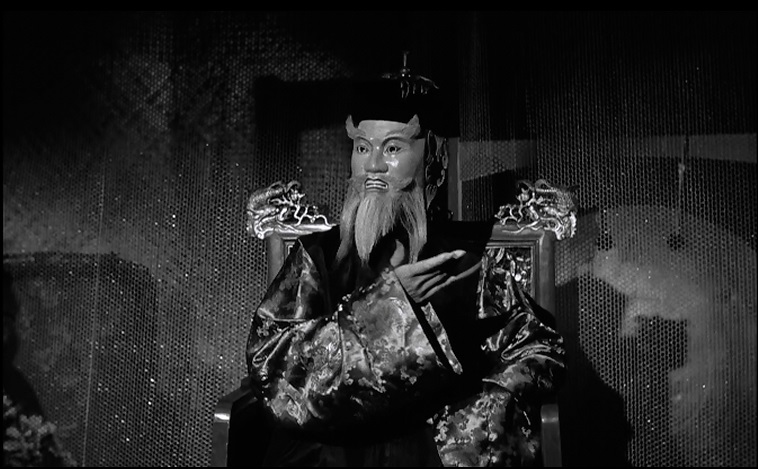
Meanwhile, back at the auction, one of the old coots gets a little too curious about the latest lot, tugs on her hair, and discovers the girl is bald. This triggers a massive snit amongst the buyers over the merchandise being damaged and they all demand to see Ling Tang -- for only his personal assurance will prove this auction was on the level. And so, for the first time in ten years, Ling Tang finally makes a public appearance. With his elderly features hidden behind a mask, he calms everyone down and introduces Lotus -- the prized lot of the auction. This quiets the crowd, the bidding starts, and the old badger who doesn’t like bald women had the highest bid until it's discovered the packaged opium he planned to use as payment was phony.

With that, the old man removes his disguise, revealing he was really George Wah -- back from the dead! At almost the exact same moment, De Quincey blows the explosives in the vault. Turns out he and Wah had the whole thing planned out this way from the beginning (... riiiiiight). And as Ling Tang’s compound goes up in smoke, Wah, Lotus, De Quincey, Lo Tsen and Baby Doll regroup and escape to the war-torn streets. Too exposed and soon surrounded, with their only chance to get away safely being through the sewers, our band scurries down the nearest manhole but, alas, Lo Tsen and Baby Doll are killed bringing up the rear.

Once in the sewer proper, Ling Tang himself confronts them. Now, the sharp eye will notice that Ling Tang is sporting a rather nice pair of pumps as he and De Quincey tangle, allowing Wah and Lotus to escape. As their struggle intensifies, De Quincey knocks the mask off, revealing that Ling Tang was really Ruby Lo this whole time! Seems the old guy actually died ten years ago and she just assumed his role. 

After that revelation, they both fall into the drainage water and are swept away by the current, locked in each other’s embrace. And as they tumble off toward the unknown, De Quincey ponders whether his current predicament was fate, destiny, or just another drug-induced dream.

You know, by the end credits of Confessions of an Opium Eater, you, as a viewer, might just be confessing to having hit the pipe yourself a few times. It’s that weird. And wonderful. Wonderfully weird. And this contact high can honestly be traced all the way back to the film’s source material.

Based loosely on Thomas De Quincey’s autobiographical book of the same name, this tale first saw print in serialized form in London Magazine, running from September through October, 1821. And though it was originally published “anonymously” in the periodical, when it was released in book format as Confession of an Opium Eater in 1822 De Quincey finally put his name on it. A laudanum (opium) addict himself, De Quincey broke his story down into two parts: The Pleasures of Opium, dealing with the factors that led to his addiction and the welcome escape the drug provided, while the second, The Pains of Opium, dealt with the price to be paid for the same narcotic addiction -- insomnia, nightmares, frightening visions, and physical deterioration.

“The sense of space, and in the end, the sense of time, were both powerfully affected,” said De Quincey about his time under the influence. “Buildings, landscapes, were exhibited in proportions so vast as the bodily eye is not fitted to conceive. Space swelled, and was amplified to an extent of unutterable infinity. This, however, did not disturb me so much as the vast expansion of time; I sometimes seemed to have lived for 70 or 100 years in one night; nay, sometimes had feelings representative of a millennium passed in that time, or, however, of a duration far beyond the limits of any human experience.”

And while the book was popular and made De Quincey both rich and famous, his vivid prose was criticized from the very beginning by his detractors for glamorizing the use of opium. Somewhat ironically, his seminal work was also considered a clinical document on the drug. Or as Judson Lyon put it in his biography of De Quincey, “Since there was little systematic study of narcotics until long after his death, De Quincey's account assumed an authoritative status and actually dominated the scientific and public views of the effects of opium for several generations."

Now, as a wise-cracking robot once noted on Mystery Science Theater 3000, in reference to Village of the Giants (1965) allegedly mutating out of the H.G. Wells’ novel, Food of the Gods, Zugsmith’s Confessions of an Opium Eater was based on De Quincey’s book in that “they were both written in English.” Scripted by Zugsmith regular Robert Hill -- Female on the Beach (1955), Raw Edge (1956), the film dropped the source author's first-hand account of a narcotic addiction and traded it in for some straight-out pulp adventure instead with a heaping dose of the “Yellow Peril” on top, as Hill apparently broke into a fortune cookie factory and then scotch-taped all those little pieces of paper together for the majority of his dialogue.

Marketed as a horror movie by Allied Artists, Confessions of an Opium Eater was, indeed, more of an action-adventure yarn straight out of the old Republic serials, while maintaining the tenuous of threads to the source material by making Gilbert De Quincey the great, great grandson of the author. Now, with that Yellow Peril taint, I fully realize this film promotes some pretty rotten stereotypes; but if you can manage to keep all of that in historical context the only real problem I had with the film was that ending. It seemed a bit contrived with the double-revelation and was kinda disappointing after such a great build up, where being forced to really pay attention as to who was double-crossing who goes all for naught. 

Zugsmith would serve as both producer and director on the film, and he kept the action moving well enough. And to help keep him on course, his crew was littered with many other notable genre veterans. Behind the camera, Joseph Biroc -- The Killer that Stalked New York (1950), 13 Ghosts (1960), made everything stark, dark or murky, making it hard to keep your bearings; couple that with Eugene Lourie’s -- The Colossus of New York (1957), The Giant Behemoth (1959), cheap but effective art direction on all those secret passages and death-traps and Albert Glasser’s -- Beginning of the End (1957), The Amazing Colossal Man (1957), eerie electronic score, which was once more cranked up to about eleven, their efforts more than overcompensate for Hill’s shaky, misdirecting script, resulting in something rather unique that is hard to explain let alone define.

I honestly wouldn’t know where to begin to try and decipher all the strange imagery and symbolism that permeates this film. I mean, What was that white horse all about? And the dead seagull? Or that whole kite thing? (You'll know it when you see it.) But the best and most jolting stream of images comes during De Quincey's attempted getaway while under the phantasmagorical influence of the opium. 

Here, Glasser’s sinister score suddenly drops out, and after a slow-motion roof-top chase, a talking bird is shot, which detonates in a cloud of feathers, and then brace yourselves for the scene in the butcher’s shop and the decapitated boar’s head. Again, What in the good-god-hell was that all about?!

I’m also convinced Confessions of an Opium Eater had at least some influence on John Carpenter’s Big Trouble in Little China (1986). And this is not a slight, nor should it be construed as a knock for theft on Carpenter's film. No sir. I enjoyed the heck out of that movie, too, but there are just far too many similarities to deny the obvious, right down to the earnest but completely in-over-his-head hero.

As a proto-Jack Burton, Vincent Price does seem a bit out of place as an action hero, but he handles it rather deftly -- hell, anything the guy does is good; and he would do it again a couple years later in The Last Man on Earth (1964), which I still contend was the best adaptation of Richard Matheson's pulp-classic, I Am Legend. Linda Ho was equally great as the vicious Ruby Lo, as was Yvonne Moray as the pithy Baby Doll. The rest of the cast -- Richard Loo, Phillip Ahn, June Kyoto Lu, Caroline Kido, were all fine but their characters were sold short by that script as filmed.

I first encountered Confessions of an Opium Eater some thirty years ago, as Souls for Sale, when it brought up the rear of an overnight triple-feature on TNT with The Giant Behemoth and The Hypnotic Eye (1960) -- back in the glory days of Monstervision and 100% Weird. And while it has since made the digital leap through the Warner Archive, I still have that VHS tape and treat it like a museum piece; a reminder of how awesome the SuperStations used to be instead of the infomercial whores they are now. Still, I am thankful and will always be grateful to the network for introducing me to this bona fide gonzo classic, and I encourage you all to catch up with it, too, as soon as possible.

Originally published on April 28, 2000, at 3B Theater.

Confessions of an Opium Eater / Souls for Sale (1962) Photoplay :: Allied Artists / P: Albert Zugsmith / AP: Robert Hill / D: Albert Zugsmith / W: Robert Hill, Thomas De Quincey (novel) / C: Joseph Biroc / E: Robert Eisen, Roy Livingston / M: Albert Glasser / S: Vincent Price, Linda Ho, Richard Loo, June Kim, Philip Ahn, Caroline Kido