With a copious amount of stock-footage and a narrator we do open, who does his best to explain what we're looking at, exactly, which is apparently the successful launch and eventual recovery of a space probe after its long round-trip to Mars.
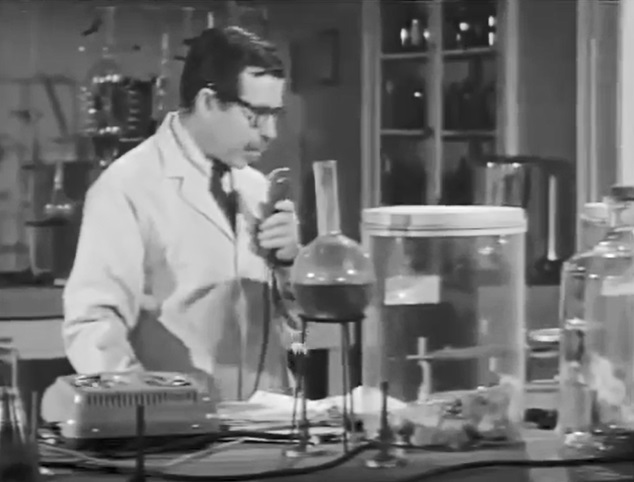
This successful operation is of particular interest to Dr. Charles Pommer (Frees) and his search for extraterrestrial life -- just not in the Little Green Men sense one usually associates with the Red Planet, and films of this vintage, but something on more of a micro-biological scale.
Apparently, government researcher Pommer pulls enough weight with this quest that he is allowed to take several samples to his home lab for further study. Here, he discovers there is indeed life on Mars: a reddish fungus that is constantly discharging more spores, meaning its growth potential is exponentially dangerous, especially when it comes into contact with any form of protein, which works as both a growth medium and an accelerant.
Now, this newly dubbed Blood Rust isn't the only thing lingering in Pommer's house, for he must also deal with Laura Greeling (Thomas), a clandestine ex-lover, who had a nine-months later consequence after their brief but extremely bitter fling.
Seems Laura is now married and wants full custody of their illegitimate son, whom she apparently left with Pommer and is now ensconced in some private boarding school. But there’s a catch: she doesn't want her new husband to know about their affair or that the child is really hers.
The lecherous Pommer eventually agrees to this ruse of an adoption and hands over some papers that will allow this; but then gets a little too grab-fanny, which results in a table-lamp to the skull and Laura rapidly leaving the premises.
Unfortunately for all involved, while distracted by the soap opera in the living room, Pommer kinda neglected even the most basic of lab safety protocols, allowing the Blood Rust to break containment.
Later, back at mission control, John Hand (Williams), special agent for the Office of Internal Security, receives a cryptic call from an obviously distressed Pommer, who warns about the alien fungus. He then orders Hand to allow no one inside his house, make no attempt at a rescue, and to burn it to the ground immediately. No questions asked. Just do it.
When the call is cut off, Hand and his partner, Joe Rattigan (Ellis), head to Pommer's house and find the lab completely overrun by the alien fungus -- and what's left of the owner before he dissolves rather gruesomely. But before they bring in the napalm, they do manage to salvage Pommer's dictated audio tapes.
Once the area is sterilized, the threat is apparently over until those tapes are spooled up, where Pommer posthumously reveals that even the minutest exposure and the simplest of transference could breed monstrous new colonies of the invasive fungus, which is compounded when a woman's voice interrupts his dictation; a woman whose identity is completely unknown; whose current location is unknown; and whose been exposed to the deadly Blood Rust…
"I don't worry about what the critics say," said independent film entrepreneur Robert L. Lippert. "I make pictures people want to see."
Now, Lippert was another in a long line of theater chain owners who were looking for a bigger piece of the box-office pie; and he decided to take the plunge into film production with Last of the Wild Horses (1948). "Every theater owner thinks he can make pictures better than the ones they sent him," said Lippert (The Los Angeles Times, September 23, 1962). "So back in 1943 [sic] I tried it."
The Los Angeles Times (September 23, 1962).
And by keeping costs down and giving the public what they wanted to see, by 1951, TIME Magazine tagged the producer as "The Quickie King" -- in reference to the speed and efficiency for which he turned out his low-budget features, which he did under several different banners: Screen Guild Productions, Lippert Pictures, and Associated Film Releasing Corp.
Known mostly for westerns and crime thrillers, Lippert wasn't averse to dabbling in other genres to keep his audiences happy; and he soon developed a solid reputation for a quality product that over-achieved beyond any budget limitations.
He backed a young Sam Fuller on films like I Shot Jesse James (1949), The Baron of Arizona (1950) and The Steel Helmet (1951). He also signed a lucrative four year deal with Hammer Films, which netted him British hits like Bad Blonde (alias The Flanagan Boy, 1953) and The Creeping Unknown (alias The Quatermass X-Periment, 1955).
And it was this frugal nature and repeated box-office success that drew 20th Century Fox's attention, who hired Lippert to run their newly formed Regal Pictures unit in 1956, which would provide B-pictures in their new CinemaScope process to fill the bottom bills for the parent studios' A-product. Of course, to keep the low end separate from the high end, Lippert’s pictures would technically be shot in “RegalScope.”
Bernard Glasser (far left) on the set of Crack in the World (1965).
Meanwhile, Bernard Glasser had obtained the film rights for the L.L. Foreman western Long Rider Jones. He shopped it around to several studios, including Fox, where Glasser had a meeting with David Brown -- yes, that David Brown, who would go on to team up with Richard D. Zanuck on JAWS (1975).
“The property was submitted to Brown, then a story editor at 20th Century Fox, and Brown indicated that the studio was interested in the property,” Glasser told Tom Weaver (Return of the B Science Fiction and Horror Heroes, 1988). But, “After meeting with Brown and [Fox production chief] Buddy Adler, I was told that they would buy the story but I could not produce the picture for Fox. I thanked Brown for his interest, but told him that my goal was to produce Long Rider Jones.”
However, when the Regal deal went down, Brown contacted Glasser again and pointed him toward Lippert. As Glasser told Weaver, “Several weeks later I received a call from Brown. He said that Bob Lippert had just signed a multiple picture contract with the studio for the production of second features; and that if I was interested in making a budget western, he would recommend my property to Lippert.” Which he was, and so Brown did.
But this would not be Glasser’s first encounter with Lippert. See, a few years prior, Glasser had teamed up with director Edward Bernds on Gold Raiders (1951), an independent western starring George O’Brien and the Three Stooges -- whose current lineup was Moe Howard, Shemp Howard and Larry Fine. “[And] while shopping for a release of Gold Raiders, I was introduced to Bob Lippert, [who] invited me to his house to screen the film for some of his associates,” said Glasser. “Lippert was pleasant, but the deal he offered for distribution was not."

Gold Raiders would eventually find a home at United Artists, but there were no hard feelings as Lippert and his Regal brain trust -- production supervisor Harry Spalding, who had final script approval, and production manager William Magginetti, who oversaw the budgets -- agreed to make the picture. The film reunited Glasser with Bernds and would be released as The Storm Rider (1957), which would be one of the first releases under the new Regal banner for Fox.
We covered Bernds career in an earlier review of High School Hellcats (1957), and so, to sum up: Bernds broke into Hollywood as a sound engineer at Columbia Pictures, but would quickly move on to writing and directing short subjects, beginning with the Three Stooges’ A Bird in the Head (1946). Bernds would continue to make Stooges shorts -- of which he wrote and directed a staggering sum. He would also move onto features, taking over the Penny Singleton and Arthur Lake Blondie adaptations with Blondie’s Secret (1948) through Beware of Blondie (1950).
Edward Bernds with Larry, Moe and Shemp.
But when Columbia downsized their B-units in 1952, Bernds left the company and spent the 1950s bouncing around between Monogram / Allied Artists and American International before signing on with Lippert and Glasser on The Storm Rider. Liking their results, Lippert assigned the duo to another budget western, Escape from Red Rock (1957). But after that, both Glasser and Bernds were ready to shake the dust off their boots and leave the sagebrush behind for something more contemporary, something bigger.
“After Ed Bernds and I had made several westerns for Regal we decided to widen our horizons,” recalled Glasser. “One of us mentioned outer space was about as wide as a horizon could get.” And it was Glasser who unearthed a script that seemed to fit the bill -- the only question was, could they afford to pull it off properly. In fact, they weren’t even sure if they could afford the script period!
“[The script] was written by my old friend Dan Mainwaring, in collaboration with a man named George Worthing Yates,” Bernds revealed to Weaver (Return of the B Science Fiction and Horror Heroes, 1988). “Their title for it was Doomsday something-or-other. They had written it on spec -- that is, they had not done it on assignment, but to be sold on the open market.”
According to Glasser, the script had been turned down by several producers as being too expensive to realize. But, “Ed and I read the script and agreed that we could make it work; but the writers, Dan Mainwaring and George Yates, wanted more money than we could afford.”
Still, Glasser was willing to try and made his pitch to Harry Spalding to meet their exorbitant asking price. “Bob Lippert knew how to choose capable employees to supervise his company,” said Glasser (Weaver, 1988). “When Lippert entered production, he sent all the scripts to Harry for comment. Harry had a good story sense and a tactful way of making criticisms.” And when Harry said no, according to Glasser, the film didn’t get made.
With scenes involving space probes, trains, and a submarine, Doomsday was pretty ambitious in scope and spectacle -- too ambitious for a Regal budget, truth told; and so, Spalding initially shot down the Doomsday deal. But Glasser was persistent. “I told Harry that I would find the extra money somewhere in the budget, and he approved the purchase.”
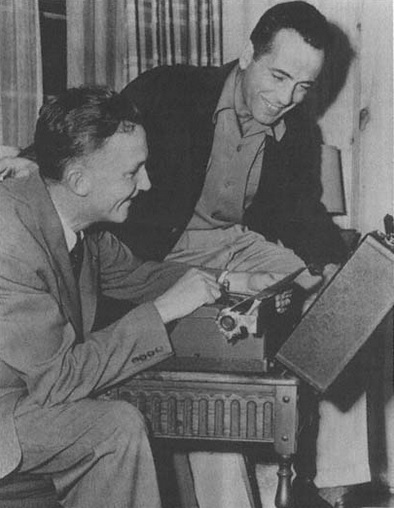
(L-R) Daniel Mainwaring and Humphrey Bogart.
And so, with the script secured, pre-production officially began on adapting Doomsday as Missile into Space. Said Bernds (Weaver, 1988), “I did an extensive rewrite job -- no extra money for that, just my fee as a director. Mainwaring and Yates had written it without regard for expense; they wrote it as a big-budget production. I had to make it fit our budget and a shorter running time.”
Bernds would get no credit on these rewrites, which suited him fine. “There were and still are credit-grabbers in the business who seize every opportunity to take credit that they may or may not deserve. I always prided myself on not grabbing credits -- I considered it part of my job to make the script work the way I wanted it to.” But not everyone was happy with his script-doctoring.
“Strangely enough, Dan Mainwaring, who had been a good friend of mine, was kind of touchy about the whole thing -- I think he thought that he should have rewritten it,” said Bernds (Weaver, 1988). “But he was probably at least a $750 a week writer, which we definitely couldn’t afford.”
Mainwaring was originally a novelist, usually under the pen name Geoffrey Homes, who had penned Build My Gallows High, later adapted to film as Out of the Past (1947) by Jacques Tourneur as a vehicle for Robert Mitchum -- and was adapted again later as Against All Odds (1984) by Taylor Hackford as a vehicle for Jeff Bridges.
Around 1947, Mainwaring would switch to screenwriting full time. When he first started, he usually adapted his own novels with No Hands on the Clock (1941), Crime by Night (1942) and Out of the Past. As for his original screenplays, he churned out several solid noirs like The Big Steal (1949), The Hitch-Hiker (1953) and The Phenix City Story (1954); and Mainwaring would also do the adaptation for Don Siegel’s Invasion of the Body Snatchers (1956); so, like Yates (-- whom we’ll be discussing in a minute), the author was no stranger to science fiction.
“Dan was kind of a neurotic person, and he was furious,” said Bernds (Weaver, 1988). “I guess he was realistic enough to know there wasn’t enough money for him, but just the idea that anybody would touch his gem!” (That’s Ed Bernds shrugging and laughing right now.)
The proposed budget for Missile into Space was estimated at $125,000. “But we had to pay Mainwaring and Yates $25,000 for their script -- $15,000 that had been set aside for it, and then an extra $10,000 that they insisted on,” said Glasser (Weaver, 1988). “That left us with an even $100,000 to lavish on our production.” (In the Bernds interview, he claimed the budget was only $90,000.) But there was one more hurdle to clear.
“Bill Magginetti’s approval of the budget was necessary before we could start shooting,” noted Glasser. “But he rejected our budget because it was too low. He was correct, but what he didn’t know was how we planned to shoot the inserts, special effects and stock footage.” They finally got the green light, but with the caveat that it “was their collective asses” on the chopping block if they went over budget.
Said Bernds (Weaver, 1988), “Glasser and I were a pretty good team: he knew that if we were to get more assignments, our pictures had to be as good as they could possibly be on a quickie budget, and he contrived to squeeze every bit of production value possible out of every dollar.”
And this he did. “We tried to lock in most of the production expenditures: music, editing, transportation, set construction, electrical, set dressing and props, etc. Ray Mercer had given us a flat deal on the special effects, which included everything, even the titles. John Link, the editor, also made a flat deal, which included everything -- sound effects, music, even negative cutting. Most of the companies we dealt with were willing to give us a flat deal because we had a continuity of production. If the companies lost money on a particular production, they knew we would try to make it up to them on the next show.”

Principal photography on the film would last only eight days. “How in the world did we ever do this in eight days?!” recalled a laughing Bernds in that Weaver interview. But at the time, “I was working under terrific pressure, making production decisions about casting, wardrobe, sets, special effects -- our assistant director was trying to make up a shooting schedule and a budget without a script to work from! I had to give him much of the information he needed verbally.”
In his rewrites, Bernds dropped the train sequence, lost the submarine, and substituted in a airplane for his climax to help shore up the costs. An obvious influence was Alfred L. Werker’s He Walked by Night (1948), another tale of a fugitive manhunt with a noirish flare.
Another was Earl McEvoy's The Killer that Stalked New York (1950), where another desperate manhunt seeks a woman wanted by the police, who doesn't realize she's patient zero for a potential smallpox outbreak, as Bernds decided to give his story a similar documentary vibe.
“We couldn’t do anything but [shoot it like a] documentary. We were all over L.A.! (They shot scenes at Union Station and at the Burbank and Long Beach airports.) It was a prime example of what could be done with very little money,” said Bernds (Weaver, 1988).
As for the fantastical elements of his script and the alien fungus, Bernds told Weaver, “I believe what the science fiction writer needs most is a sense of story and enough science to make the story work.”
He would also get some additional editorial help from Spalding. “Spalding was an excellent man to work with,” said Bernds (ibid). “A lot of story editors try to prove they’re smarter than the people they’re dealing with, but Harry was anxious to cooperate, and his suggestions were generally helpful. I was told that Lippert never read a script, that he depended on Harry to read them and then tell him what they were about."
And it was this kind of “hands off” cooperation from the top down that helped grease the wheels on these Lippert productions.
When Weaver interviewed Harry Spalding (Double Feature Creature Attack, 2003), he remembered that, “We had to go over budget on the script, but actually the thing I remember more about the overall situation there was that Bernard Glasser and Ed Bernds did a very good job. Ed was just great to get along with, a capable writer and director, and Bernie had lots of production experience. In an outfit like ours, where we were making a lot of pictures with a small staff, it was great to have units that you could turn the picture over to, and not worry about anything other than acts of God.”

“It was an example of independent movie-making at its best,” concluded Bernds (Weaver, 1988). “At Lippert, you had freedom to do it as you saw fit. True, you only had $90,000 to spend, but Glasser and I could do anything we pleased with it. All we had to do was bring back a good product for the money. It was made with near 100-percent efficiency and near 100-percent freedom. Lippert and Spalding looked at the rushes, made occasional suggestions, but in the main Glasser and I made the picture our way. Glasser attended mostly to money matters, and I mainly to the creative aspects.”
But the one thing Glasser and Bernds didn’t have final say on was the film’s title. No. It was Lippert’s PR chief Marty Weiser who officially changed the name from Missile into Space to Space Master X-7 (1958). Said Glasser (Weaver, 1988), “He claimed that his title was more imaginative and less ‘on the nose’ -- and we agreed with him.”
Now, despite Bernds’ extensive rewrites, you can still sense the bones of Yates’ original story -- or at least the vibe of it. Yates had written the Sci-Fi classic THEM! (1954), a tale of rampaging giant ants that gestated in the fallout at White Sands, and he would spend the rest of his career basically rehashing that same script over and over again by just subbing in a new root-cause monster in things like It Came from Beneath the Sea (1955), The Amazing Colossal Man (1957) and The Flame Barrier (1958).
But even with Bernds' streamlining, Space Master X-7 is still basically the same story: introduce a menace in the first act; nail down what that menace is in the second act and begin pursuit; and then the third act amps up the tension as the menace is methodically tracked down and destroyed.
The Grand Island Independent (May, 1953).
Sure, it gets off to a bit of a hackneyed start, but once the stock-footage abuse calms down and the contrived soap opera subplot between Pommer and Greeling is established and out of the way, Space Master X-7 settles into a nice little groove as it takes on a no-nonsense police procedural vibe -- think Dragnet with an X-Files twist; or better yet, The Magnetic Monster (1953) or The Creeping Unknown -- as our protagonists doggedly pursue their slippery quarry, who doesn't realize the danger she's in or the extinction level contagion she is carrying.
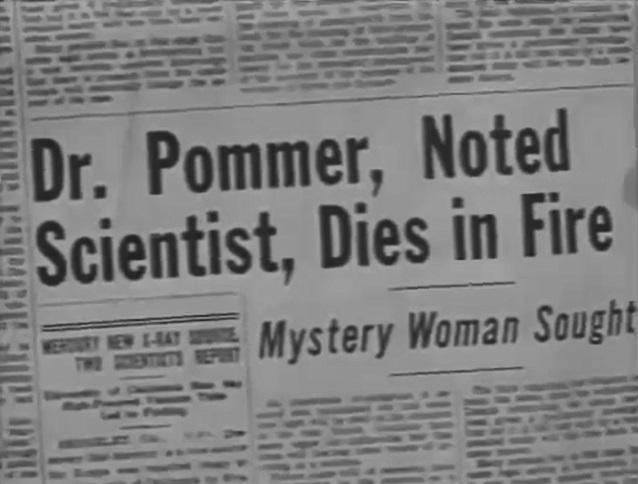
Thus, as the hunt for this Intergalactic Typhoid Mary quickly gets up to speed, the decision is made to keep quiet on the invasive alien fungus to prevent any panic and Pommer's death is passed off as a victim of a house-fire.
Alas, the "mystery woman" wanted for questioning in connection with that fire in all the papers and news bulletins misconstrues the intent, believing they think she caused the fire and the resulting fatality; and so, Laura Greeling does her best to cover her trail as she travels from New Mexico to California, looking to get on a flight to Hawaii, where her husband, who has no idea what she's been up to, is due back in a couple of days. And all the while, unwittingly leaving bits of Blood Rust behind and a deadly trail of fungal colonies and liquefied victims for Hand and Rattigan to follow.
The first big break in their case comes when Hand plays a hunch that their mystery woman might’ve taken a cab to Pommer’s remote house. Further investigation leads them to a cabbie named Retlinger (Howard), but he denies ever taking a fare to that address -- at least at first.
Retlinger changes his mind when Hand mentions how they need to find this woman immediately for emergency medical treatment, how she’s been exposed to something toxic, and how her life is at stake. Fearing he might’ve been exposed, too, and thinking it might involve atomic radiation, the cabbie admits how the woman gave him $20 to forget he ever saw her. He then informs that he took this woman, he never got her name, to the train station, where she booked her luggage through to Los Angeles.
With that, Retlinger is taken into protective custody for decontamination and his cab is seized to be sterilized and destroyed. Hand and Rattigan then commandeer military transport to California, where they hope to beat Laura’s slower-moving train to its destination. But they’re not quite fast enough.
When the train arrives, Laura gets her first dose of headlines that say the authorities are looking for her. And so, with only her purse and small carry-on, she abandons her other luggage and flees the station just as the authorities arrive.
As for her luggage, it’s still ensconced inside the baggage car. Apparently, another colony of Blood Rust erupted while the train was in transit and the compartment was sealed off -- but not before it ate one of the crew. Now the entire car has been isolated at the rail yard, and Rattigan gears up in a protective hazmat suit as Hand explains to the local authorities what they’re up against.
Then, armed with a flamethrower, Rattigan enters the train car, hoping to retrieve the woman’s distinctive suitcase (-- thanks to a description by the cabbie). The interior is completely inundated by the ever-expanding Blood Rust. But as it comes for him, the agent is able to keep it at bay with the flames until he manages to locate and extract Laura’s suitcase, hoping it will contain some clue to the woman’s identity. And once he’s clear, the train car is sterilized and immolated. No trace of the Blood Rust may be left to spore again.
Meanwhile, Laura has holed up in a cafe, where she awaits a call from the airline to see if she can bump her return flight up a couple of days. Here, the TV behind the counter suddenly shows a police sketch of her -- again, courtesy of Retlinger. An all points bulletin has been issued for any woman matching this description and the public is asked to contact the authorities if they spot her.
With that, the fugitive sequesters herself in a hotel room and starts making some calls for a few deliveries, which nets her a new change of clothes and some cosmetics to change her appearance, including some dye to change her hair from a blonde to a brunette. She also checks in with the airline again, who happily report they have a cancellation and there will be a seat available on the 11pm flight later that night.
Elsewhere, Hand and Rattigan impatiently wait as the confiscated suitcase finishes going through decontamination. Inside, all they find is high end clothes but nothing to identify the owner. But then Rattigan spots something in the sleeve: an invoice for a plane ticket to Hawaii -- but it doesn’t say for who or exactly when the flight is. And so, now all they know is they’re looking for a well dressed, petite blonde who is trying to catch a plane for Hawaii.
But then they get a tip from a concerned citizen -- namely a hotel clerk (Sherman), who is certain the woman they are looking for has checked into his establishment. Alas, by the time they arrive, Laura has completed her makeover and has abandoned the room.
But they do find the empty packages and receipts for the clothes she bought, including one for a tweed jacket, and find the hair dye, so they know they’re now looking for a brunette and not a blonde. They also get a name: Alice Thompson, but aren’t sure if this was her real name or an assumed alias.
The nosy clerk also listened in on her phone calls, who informs the Thompson woman talked to an airline and had booked a ticket to Honolulu for later that night. He even has the name of the airline. Also among the evidence at the hotel, they find another colony of Blood Rust oozing its way out of Laura’s abandoned purse. Here, Hand sends Rattigan onto the airport while he remains behind to neutralize the fungus.
At the airport, Laura manages to get on the red eye flight under her real name. Not too far behind her, Rattigan approaches the airline desk and asks if an Alice Thompson has checked in for a flight. The clerk says no; in fact, they’ve been paging her for the last five minutes but it’s now too late. The flight to Honolulu is loaded, sealed, and ready for take-off.
Asked if any good looking brunettes in a tweed coat managed to get on the flight, the clerk confirms that there were three such women on board who match that rather vague description.
Inside the plane, as the boarding hatch is closed, Laura finally breathes a sigh of relief, thinking she has made good on her escape. But this is short-lived as the plane is held up before it can taxi to the runway, allowing one last passenger to get on: Rattigan.
Now, why they don’t just ground the plane at this point is beyond me, but instead, it is allowed to take off. Once they’re airborne, Rattigan informs the flight crew of what could be on board and then conspires with the head flight attendant (Williams) to clear the lounge area, and then bring the three probable suspect brunettes there, one at a time, for questioning.
Here, the pilot warns that they’re against the clock. In just a few hours they’ll be beyond the point of no return and will have no choice but to go onto their destination. (Again, why not just turn around now?!)
And so, Rattigan begins his interrogations, but plays it soft so as not to scare the suspect off or cause a panic. The first two women, including Laura, are able to identify themselves with their credentials. (They still don’t know her real name, remember.) But the third cannot, claiming she must have packed her ID in her suitcase, which is currently ensconced below in the luggage compartment; where, unbeknownst to those above, a massive colony of Blood Rust has erupted and is growing bigger and bigger by the second.
Meanwhile, Rattigan has narrowed his suspects down to Laura and the woman without the ID. And to clear that up, he will need access to her luggage. With an assist from the flight engineer, they pop open a hatch to gain access from the cabin, only to discover a roiling sea of Blood Rust below.
With the cat now officially out of the bag, Laura finally fesses up to who she is and why she was avoiding the authorities all along.
But this confession might’ve come too late as the plane alters course and heads back to California, where Hand instructs the pilot from the control tower to head for the Oxnard Air Force base, which is the closest landing area with the facilities to neutralize the Blood Rust -- which is currently about 2 hours away.
Suddenly! The cabin loses pressure, and the flight crew determine the fungus must have broken out the loading hatches. This is confirmed when the blob-like fungus starts covering the windows, probing and prodding for more sustenance.
Here, taking a page from the McQueen handbook, Rattigan and the engineer use fire extinguishers to hold the menace back as the harrowing minutes tick by until the plane finally has the runway in sight.
But! There’s a problem. The rampant fungus has fouled up the landing gear, meaning they will have to make a treacherous belly-landing. And as the passengers brace for impact, the pilots prove up to the task as the plane lands -- well, technically crashes -- onto the runway and skids to a halt.
Here, the shaken passengers are escorted out of the plane and loaded onto busses, where they will be hauled off for decontamination and a debriefing, while the Blood Rust is put to flame, which brings our tale of a marauding alien fungus and the harrowing manhunt to...
You wanna hear something funny? Despite Glasser's creative shoestring budgeting and Bernds' tight direction and uncredited rewrites, Space Master X-7 most probably owes the greatest debt to, believe it or not, Moe Howard.
Now, the leader of the Stooges had been out of work ever since Columbia pulled the plug on its shorts department. And when he sent out feelers to Bernds to see if he had any work for him, the director happily cast him in the role of the pivotal cab driver -- the only one who knew what their fugitive looked like; and Howard's performance is a highlight of the film -- especially the scene where he’s working with the sketch artist. (“She had those eyelashes, you know, the ones they pull out with pliers.”)
"We’d been friends ever since I began directing the Stooges, so I was glad to cast him," said Bernds (Weaver,1988). “Moe did the part not because he needed the money, but because he loved acting -- he really did. The thing he missed most about the Three Stooges two-reelers being terminated at Columbia was that he couldn’t work any more."
Once hired, Howard pushed his luck and asked if there were any openings for his son-in-law, Norman Maurer, on the picture, too. “Moe had asked us if there was a place on our production team for him. He said that Norman would work without a salary in order to learn the film business,” said Glasser (Weaver,1988).
A comic book illustrator by trade, at the time, Maurer had been married to Joan Howard since 1947 and was now looking to break into the film industry. “I knew him as a professional artist of considerable talent,” added Bernds (Weaver,1988). “Moe told us that Norman wanted to get a foothold in the production end of motion pictures and asked us to take him on as a production assistant. An artist can be a great asset to a motion picture, so we were glad to do it.” Especially since it didn’t cost them anything.
“He was an enthusiastic person brimming with suggestions for the special effects in the script,” said Glasser (Weaver,1988). For his audition, Maurer invited Glasser to his house and showed him conceptual sketches on how to realize the film's undulating, blob-like menace.
Said Bernds (ibid), “Norman was a hard worker and made a big contribution to Space Master X-7; he gave the special effects men sketches of the Blood Rust, sketches that we could agree on before any money was spent on experimental presentations.”
As for the practical application of these concepts, with an uncredited assist from Don Post, “The effect was composed of a foam rubber rug about a yard square,” said Glasser (ibid). “Several different models were made at a latex factory in Hollywood. Norman and I supervised this operation. These latex rugs looked like miniature volcanoes. In the vortex of each volcano, Norman inserted a plastic tube. Compressed air forced a red powder through the tube and out of the vortex. Compressed air was also utilized to make the rug sections undulate. The entire effort cost us less than $1000.”
Unfortunately, due to the tight budget, the killing of the baggage handler happens off screen. But as Bernds pointed out to Weaver, as a sobering thought, the entire budget of Space Master X-7 wouldn’t buy a four minute sequence in Star Wars (1977) or Raiders of the Lost Ark (1980).
Sure, the Blood Rust at times looked less like a volcano of death and more like a failed attempt at a World’s Record for the biggest fried egg sandwich; but their end results, despite the budget limitations, were really quite effective and delightfully gruesome as the alien fungus consumed its victims. Hell, that moment when they discover what’s left of Pommer being eaten is downright disturbing. Others disagreed.
“Of course we made all kinds of obscene remarks about the Blood Rust when we were shooting the picture, because it looked so awful,” Lyn Thomas recalled to Weaver (Science Fiction Confidential, 2002). “The special effects men were trying so hard to make it look scary, and all we came up with were sexual innuendos.” But Thomas would admit, “It looked a lot better in the movie than on the set; on the set, it was really gross.”
A former Gerber baby, Jacqueline Thomas was pushed into show business by her mother. While performing in a play she was spotted by a talent scout for MGM, who told the actress to cap her teeth and come to Hollywood, which she did. There, she kicked around between Eagle Lion and Hal Wallis, who convinced her to change her name to Lyn because Jacqueline took up too much space on the marquee.
Alas, despite a few plum roles in films like Stage Struck (1948) and Black Midnight (1949), Thomas never really gained any traction. Not helping matters was that she was blackballed as "being difficult” by Howard Hughes after she refused to sleep with him after giving her a screen test.
But then Thomas caught Lippert’s eye. “Well, he kinda liked me (laughs) -- we can leave it at that,” Thomas told Weaver. “And so, whenever he got a chance, he would shove me in as his leading lady. Fortunately, most of the time I didn’t disappoint.” As far as I can tell, her part as Laura Greeling in Space Master X-7 was the first film Thomas did for Lippert, which was followed up with Frontier Gun (1958) and Alaska Passage (1959).
As for her co-star, Paul Frees, “He was kind of strange, kinda like a method actor,” said Thomas (Weaver, 2004). “He was nice, but not the type that was funny and jolly to be around -- he had to concentrate on the part.”
Frees, of course, was a legendary voice actor. He started in vaudeville as an impressionist and then moved to radio. And during his 40 year career, he appeared in some capacity in over 250 films, cartoons and TV shows. He did a lot of cartoon work for Walt Disney -- a personal favorite being Mars and Beyond (1957), and provided the narration for both The Haunted Mansion and The Pirates of the Caribbean attractions / rides.
(L-R) Ludwig Von Drake and Paul Frees.
He also did a lot of work for Jay Ward Productions, where he famously gave voice to Boris Badenov for the Rocky and Bullwinkle cartoons, plus countless others for Rankin / Bass, Hanna-Barbera, and George Pal. He also did a lot of dubbing, most famously when the Woolner Brothers imported Mario Bava’s Blood and Black Lace (alias Sei donne per l'assassino, 1964), where Frees provided the distinct voices for nearly all the male cast!
As for filming Space Master X-7 and working with Glasser and Bernds, said Thomas (Weaver, 2004), “Ed Bernds, the director, was a doll even though he was under a lot of pressure. They had to get so many scenes, so fast, we had to shoot x-number of pages every day. And if we didn’t, somebody above screamed and hollered. There were lots of times he had to print things that he wasn’t happy with because of the time element. Glasser was the one who was pushin’ all the time. And you hoped that in editing, they could make it look good.”
This made for some long days and some very short nights. “You worked a lot of Golden Time -- anything after eight hours was double-time and after 12 hours was Golden Time,” explained Thomas (ibid). “I was lucky if I got four or five hours of sleep between each day. That was the way with all B pictures in those days, they were shot so fast, and late into the night.”
When the film was finally finished, it was turned over to Lippert, who then turned it over to Fox. “20th Century Fox financed and released Regal Films but had nothing to do with them until Lippert turned them over as a finished product,” said Bernds (Weaver, 1988). “To my knowledge, Fox didn’t even have veto power over the cast, and I don’t think they even looked at the final cut of the pictures.”
Bernds would then explain further, “Fox executives, even the lower-echelon ones, never looked at the final cuts. There may have been several reasons for that; maybe even the lower-echelon producers were too snobbish to get involved with Lippert’s low budget process, or perhaps they felt they were not equal to making decisions at that level of filmmaking. But most likely, Bob Lippert -- a rough, tough customer -- just didn’t want any kibitzing on his films, and this autonomy may have been part of his deal.”
Initially, Fox released Space Master X-7 as a second feature for The Fly (1958), and the Sci-Fi combo did gangbusters at the box-office despite the bottom bill being nearly squeezed out of all the ad-mats; and the second feature's rather nonsensical title; and the highly misleading promotional campaign, which said the premiere would be held in Florida, including a tour of Cape Canaveral, with Thomas and co-star Bill Williams in attendance.
The Los Angeles Times (July 18, 1958).
Said Thomas on this particular odious piece of ballyhoo bullshit (Weaver, 2004), “Oh, my God, no. Oh, my Lord! I’ve never been to Cape Canaveral! Isn't it amazing what they can make the public believe?”
Regardless, “Space Master did very well for Lippert and Regal,” said Glasser (Weaver, 1988). “Fox billed Space Master with The Fly, and this combination out-grossed many of the more expensive Fox productions. Lippert became a celebrity on the Fox lot, and the Regal low budget films were the main topic of conversation in the Fox commissary.”
But then, as Glasser continued, “The Fox distribution department pulled Space Master from the bill and replaced it with an expensive Fox picture that was not getting good grosses. The revised bill did not do well. The chemistry of two science fiction pictures on the same bill was the key.”
The film was buoyed by a solid cast, a no-nonsense plot, cheap but engaging special effects, and had such an engrossing, ticking-clock manhunt one can easily forgive the shaky, stock-footage dictated air-disaster climax. Said Glasser (ibid), “We had seen some exciting stock footage of an airliner’s ‘wheels up’ landing and decided to utilize it for a big, inexpensive ending for the picture.”
And aside from ever letting that plane off the ground in the first place, the only other nitpick I have with this movie, and it's a small one, was that it just kinda abruptly ends once the plane has safely landed with everyone going their separate ways. Said Glasser (ibid), “In editing we deleted an office tag scene by the government official who opened the film. We felt that once the plane landed, the movie was over.”
Alas, not very many people have had the pleasure of experiencing Space Master X-7. For some reason, the film fell through the cracks when it came to TV syndication, failing to be added to any fright-film packages.
You used to be able to find a rip of it on YouTube or Dailymotion but those appear to have all been copyright curb-stomped out of existence -- except for a pretty cool trailer. The only copy I could find currently streaming online was a rather shitty, pan ‘n’ scan dub at the Internet Archive. There was a bootleg VHS by Hellfire Video, and at last check there appears to be a no-frills DVD-R available to buy on Amazon in true Regalscope.
This is good news all around because Space Master X-7 has been wallowing in relative obscurity for far too long, and that needs to change because you all are missing out on one crackerjack Sci-Fi epic done in eight days for almost nothing.
Originally posted on October 24, 2015, at Micro-Brewed Reviews.
Space Master X-7 (1958) Regal Films :: 20th Century Fox Film Corporation / P: Bernard Glasser / AP: Norman Maurer / D: Edward Bernds / W: George Worthing Yates, Daniel Mainwaring, Edward Bernds / C: Brydon Baker / E: John F. Link Sr. / M: Josef Zimanich / S: Bill Williams, Lyn Thomas, Robert Ellis, Paul Frees, Moe Howard