

We begin somewhere in the bowels of the science building at the Addison Poly-Technical Institute, where some dubious animal experiments are coming to a head; a baboon’s head to be more precise, as a Professor Sorenson finishes drilling a hole in a primate’s skull so his assistant, Richard, can directly inject some Corticotropin directly into its brain matter.
Now, all of this invasive surgery is part of an effort to soothe the primal instincts of one of the most vicious animals on the planet (-- well, at least according to the back of the DVD case). But from what little I read and understood about the drug online, what they’re trying will not work so, yeah, this quackery will most likely all end in fire for everyone involved -- especially the unwilling patient.


Also of note, during the whole procedure, Richard (Flowers), in an ever-escalating effort to suck-up to his teacher, keeps pestering Sorenson (McDowall) about participating in ‘The Game.’ But Sorenson, seeing right through this, informs Richard it's not his decision to make but Sam’s, a fellow student, who set it all up and is in charge.
And what is this ‘Game’ they speak of? Well, we’ll get to that in just a second. For now, cut to the specimen room, where Sam (Atkins) appears to be the head wrangler of all the animals caged-up in there, destined to be experimented on, where he is currently involved in a romantic kerfuffle with his girlfriend, Tracy (Wyss). This is interrupted when Richard wheels in the still anesthetized baboon, whom Sam recognizes as Shakma, one of his favorite critters of this menagerie, and is none too happy about him being experimented on. (My dude, do YOU ever have the wrong job.)


Meanwhile, as Richard makes his plea to be part of the impending Game, Shakma wakes up and goes berserk. Seems Sorenson’s experiments to calm his subject matter actually backfired with the opposite effect, ramping up the specimen’s aggression to unprecedented levels. Luckily, Sam manages to tranquilize the beast before he can do much damage to Richard. And seeing his experiment is a total bust, Sorenson orders a reluctant Sam to euthanize the test-subject.
Here, the dominoes of disaster start falling when Richard, still in pestering mode, distracts Sam long enough that he grabs the wrong vial and essentially gives the somnolent Shakma a placebo instead of a lethal injection. But this insistence also pays off when Sam finally relents and allows Richard to participate in the Game; and here, we finally get an inkling as to what this game is when Richard is awarded the role of Nemesis, a demon who lurks in a maze that pounces on unwary Quest Knights.


E’yup. We’re dealing with some kind of Dungeons and Dragons knock-off (-- with the serial numbers filed off enough so TSR couldn’t sue). And not just some K-Mart version, either. We’re talking about a live-action, first person spell-caster, where instead of just sitting around a table, Sam has talked Sorenson, a fellow gamer, into letting them use the whole science building as an ersatz tabletop -- six whole stories worth of makeshift mazes and dungeons to explore, with clues to unravel, weapons to gather, and treasures to be found on each floor.
To make this elaborate scheme work, Sam has employed Bradley (Laughlin), a fellow tech nerd and gum-chewing enthusiast, to rig up some handy contrivances -- sorry, I mean, handy digital trackers and one-way walkie-talkies that will only allow each gamer to communicate with the [Not the Dungeon Master but the] Game-Master, Sorenson, who will track them all on a monitor and prompt them along, with the winner being whoever solves all the riddles, collects all the artifacts, avoids the Nemesis, and reaches the top floor first, where a princess awaits to be rescued.


With that, the game to end all games of Quest Knights is set to start that very evening once the building is cleared out and locked-up for the weekend. But before all of that happens, Richard relieves a distraught Sam from the grisly task of disposing Shakma’s corpse. And he’s just about to chuck the alleged remains into the incinerator when those disaster dominoes keep on tumbling as Sorenson just happens to wander in at that exact moment and stops him, saying he wants to perform an autopsy to try and salvage some data from this disaster.
Thus, the presumed dead Shakma is left unattended and unrestrained in the darkened specimen room. And later that night, as our principals gather below to start the game, Shakma wakes up, good and pissed, and clandestinely slaughters all the other animals in the lab (-- a startling effective off-camera moment played out with dismembered furniture and distressed animal sounds). Thus and so, with no idea what is awaiting them several floors above, the players are set, the maze is set, and the clues are waiting. Let the game begin...


One of the most disturbing things I have ever seen in a nature documentary was a group of chimpanzees running down another species of monkey in the jungle, catching it, and after a brief pause, as the camera zoomed in on the look of sheer terror in their captured prey’s eyes, these primates rapidly tore it asunder, shredding it in a plume of blood and viscera, and, eventually, consuming it. (Thank you, PBS.)
Of course there have been many documented cases where chimps have attacked humans. There’s the infamous case out of Connecticut, where a domesticated and heavily medicated chimp named Travis went berserk and mauled a woman, destroying her face and hands in the process. (I recall the 911 operator wouldn’t believe the owner until she started screaming, “He’s eating her!”) Another case has a California couple who adopted a baby chimp named Moe, but later had to turn him over to a sanctuary when he got too big to handle, where they were then attacked by two escaped chimps while visiting their “baby” with the husband losing most of his face, fingers and genitals in the process.

The San Luis Obispo Tribune (02/20/2009)
What I’ve taken from all of this carnage is, essentially, chimpanzees are assholes. Now, our film today does not concern a chimp but a baboon, which are mostly known for their massive fangs and terrifyingly toothy grimace, it’s comically red rear-end, and a well-earned reputation for being one of the most aggressive animals on the planet.
One of the most notorious accounts of these animals comes from Africa circa 1984 during the massive drought (-- the same drought that spawned Band-Aid and Live-Aid), which resulted in large packs of starving baboons brazenly attacking several Kenyan villages and killing dozens of natives in a search for food. This incident was adapted to film with In the Shadows of Kilimanjaro (1986), but while the trailer for that looks amazing, from what I’ve read, the actual film is a whole six-pack of squandered opportunity.


And even though the fantastic Frank McCarthy poster art promises us one thing, no baboon ever takes up an axe in Sands of the Kalahari (1965). But it’s still pretty great as Stuart Whitman comes down with a terminal case of alpha-maleitus as a group of plane crash survivors try to stay alive while marooned in the wilds of Africa. Here, Whitman goes all Ahab, in a Leslie Nielson, Day of the Animals (1977) sense, when he tries to appoint himself leader of a roving pack of vicious baboons. This, does not go well.
Of course, another group of baboons attacked Lee Remick’s car in The Omen (1978) when they sniffed out the Anti-Christ buckled in the passenger seat. And then there’s Shakma (1990), where a baboon essentially serves as a surrogate Jason Vorhees as a lab animal systematically kills off a group of college students locked in a building, turning the tables by making them the unwitting rats in a maze as they blow a Friday night playing out some fantasy game.

Hugh Parks (Right).
The film was the brain-child of Hugh Parks, a former aerospace engineer and defense contractor for Martin-Marietta. In 1982, Parks quit Martin after 22-years of service and struck out on his own, co-founding Parks-Jaggers Aerospace in Orlando, Florida, which he later sold for $3.3 million to pursue his lifelong dream of making movies. And so, Parks’ next business venture was Quest Entertainment, which he founded in 1986. And Parks would remain based out of Orlando, which he hoped to turn into what he called “Hollywood East.”
"He was a good technical person and a very good marketing guy. He was good at selling and developing new ideas," said Bill Schwartz, who worked at Martin-Marietta with Parks. (The Orlando Sentinel, March 20, 1997). His first feature was After School (1988), where a Catholic priest falls for a young coed while prepping to mount a defense of Creationism on a televised debate. As a surprise to no one, the film failed to find an audience. Undaunted, Parks tried again with the suspense thriller, Deadly Innocents (1989). “A tale of murder and seduction by a schizophrenic Jezebel and her naive accomplice,” according to Catherin Hinman (The Orlando Sentinel, July 23, 1989), and whose poster promised: “One is young and naive. The other is dangerous. Together they will kill you with desire.”

Parks co-wrote both features, saying to Hinman, “I don’t want to be so unusual that we are out of the marketplace. We need to be commercial.” At the time of the article, Parks and Quest’s goals were to produce at least six features annually with at least two budgeted at $6-million apiece. And to those ends, Quest Entertainment shelled out a couple of horror films -- Darkroom (1989) and Luther the Geek (1989), a boner comedy -- The Dream Trap (1990), a bizarre combo of Enter the Ninja (1981) and Police Academy (1984) -- Ninja Academy (1989), and an Indiana Jones clone -- The Spring (1990), where a couple of archaeologist find Ponce de Leon’s diary and search for the Fountain of Youth in the parking lot shrubbery of a La Quinta Inn somewhere in south Florida.
Hinman would revisit Parks and his progress about six months later (The Orlando Sentinel, January 9, 1990), saying, rather diplomatically, that “In his short career as a movie producer, Hugh Parks of Orlando’s Quest Studios has distinguished himself more by his ability to get movies made (no small feat) than by what he produced. Quest's films are no worse than those of any other low-budget producer. [But] the question has always been will the studio rise to the next level of the medium?”

With the exception of After School, everything Quest had produced thus far had failed to garner a theatrical release and went straight to video. But now, Hinman insisted, the studio seemed to have finally found the breakthrough formula with a killer-monkey movie called Nemesis -- the shooting title for Shakma.
Parks was set to direct this latest feature but turned to Roger Engle, another Florida native, for the script. “I wanted to write a youth-oriented horror film based on the ‘enclosed universe’ device often used in science fiction writing,” said Engle in an interview with Lesia Paine (Johnson City Press, September 7, 1990). “Where you seal off a group of characters from help, and introduce a malevolent force they have to defeat using their own resources.”


In the early stages, Engle toyed with the idea of a tiger mascot getting loose in a football stadium, where it would terrorize the staff in the catacombs beneath it. “But I wanted to add a dimension of intelligence to the story,” said Engle. “Eventually, it became obvious to use a primate.” And from there, the script started to take shape. “We’ve created suspenseful sequences that will hopefully keep audience members on the edge of their seats, then hurl them back in sheer terror.”
But before we reach this promised sheer terror, where the flesh hits the fangs of the maddened primate, the noble Quest Knights first gather on the ground floor: Sam, Tracy, Bradley, and their friend, Gary (Morris), with Richard hiding somewhere several floors up as the masked Nemesis. And then there’s Richard’s little sister, Kim (Meyers), playing the role of the princess held “prisoner” on the top floor, who has a not-so-secret crush on Sam, which serves no real purpose except to be exploited as some filler later on; and finally, Sorenson, ensconced in his office on the fifth floor with a pile of radios on his desk and a rudimentary digital version of the playing field on his computer monitor


Thus, as the Game officially begins, to up the ante a bit, the gathered Knights place a wager on who will win with each pitching $500 into the pot. And what kind of college student has that kind of scratch lying around to waste on something like this? Well, that’s me shrugging right now. As to who wins? Well, Spoilers Ahoy from here on out.
Now, despite the kit-bashed nature, this elaborate game actually makes some sense and progresses rather smoothly until the first player reaches the fourth floor, where what’s left of the specimen lab is located. Hearing what he thinks is Nemesis lurking inside, Bradley heads in, tossing his magic neutralizing glitter as he goes. Surprised to find the place torn to pieces, the unwitting player barely has time to react to this before being attacked and killed -- not by the Nemesis, but by Shakma, who rips out Bradley’s throat before he can call for help


Later, when Sorenson can’t raise him on the radio, thinking it's just some technical glitch, he orders Richard to break character and go check on Bradley, which he does, heading to his last known location, where he is also attacked by Shakma. But this latest victim manages to take temporary refuge in a storage closet with a handy jug of hydrochloric acid. Thus, armed with a beaker full of caustic liquid, Richard makes a break for the door, is attacked, and his defense strategy completely backfires when all of that acid winds up splashed onto his own face.
Meanwhile, as their friends dissolve rather gruesomely or are slowly consumed by a rabid monkey one floor up, Sam and Tracy also break character when these two errant Knights pause for some *ahem* ‘savage manhood lancing’ on top of a desk.


Meanwhile, meanwhile, two floors up, now unable to contact anybody, Sorenson takes the elevator down to level four to see what happened to his missing players. Here, he finds what’s left of Richard and beats feet back to the elevator so he can warn everyone else that something has gone staggeringly awry. Alas, Shakma charges from out of the darkness and mauls him before the elevator doors can close; and with his dead body now blocking said doors, the lone elevator in the building has now been rendered useless.
Below, rousted from their nookie time-out by all that noise, as they try to head up, Sam and Tracy can hear the elevator door pinging as it fails to close above them. Forced to take the stairs, they soon find out why the lift is currently out of order: Sorenson, his face now gone, completely chewed away.

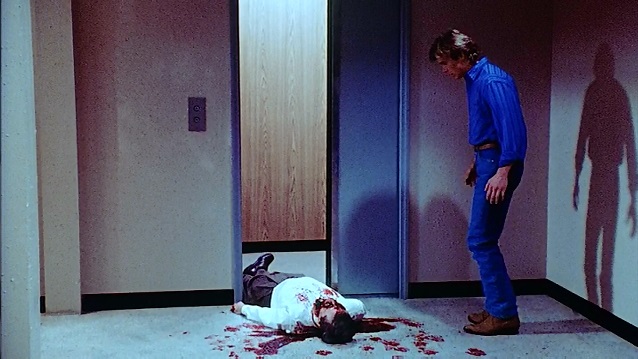
From there, things really hit the fan as the film ratchets things up, tension wise, with a deadly game of cat and mouse as Shakma chases the surviving players from room to room, turning himself into a battering ram, with nothing but a series of flimsy doors that won’t lock in between them!
Now, my understanding is that the name Shakma is probably derived from chacma, a species of baboon that was featured in some of those other baboon-centric movies I mentioned earlier. However, it should be pointed out the baboon in Shakma is not a chacma at all but a hamadryas, which can be easily identified by his balding noggin and Larry Fine hairdo (-- and no surgical scars, I might add).


Apparently difficult to train and easily spooked, sadly, one should also note that Typhoon, our starring baboon (-- 10 years old at the time of production, and weighing in at 63-pounds), has had his canines and several other teeth removed -- like those much ballyhooed ‘live sharks’ in Mako: Jaws of Death (1976), which kind of makes all of his close-ups look less like a savage simian and more like a cranky old coot who wants everyone to get off his lawn.
Normally coaxed into action by “affection and treats that included Kentucky Fried Chicken,” for the all-out frenzy scenes, where the film truly excels, and the baboon goes, forgive me, completely ape-shit while trying to get at someone, other tactics were employed. See, to achieve these scenes, when the usual disruption of the pecking order failed to get the needed result, the animal wranglers brought in a female baboon that was in heat and placed her on the other side of the target door. Also, to prevent the manic baboon from running off, a series of glorified electric fences were employed to keep it contained in the camera’s eye.


And the end result of these dubious tactics on film are kind of amazing; and this arousal method is kinda confirmed by the appearance of the baboon’s very obvious erection, which cannot be unnoticed once you spot his dingus flopping around. And you do see it. A lot. As star Christopher Atkins revealed in a later interview with ComingSoon.net (August 10, 2016), "When the baboon got really angry and really crazy it would always get a hard on! The director would always yell out, 'One more time without the hard on, please!'"
Also of note, I have an apocryphal memory of Wings Hauser (I think) appearing on some daytime talk show many, many years ago, where he talked about how his family used to live across the street from Bob “Gilligan” Denver’s house, who apparently owned a monkey of some kind; and when it was his sisters' 'time of the month' and the wind was blowing in the right direction, they could hear said monkey completely losing his shit.
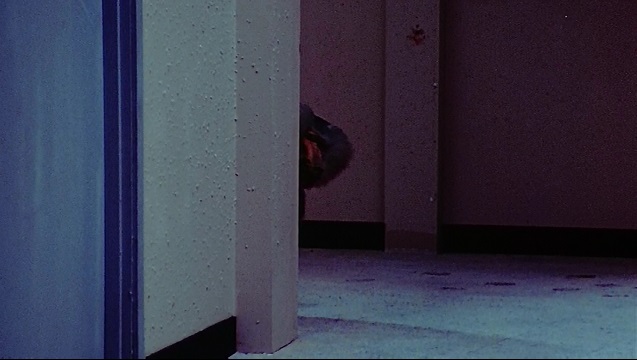

This tale holds water, too, as during the filming of Shakma any female cast or crew member who was menstruating at the time was barred from the set. The actors were also warned by the handlers to never look the baboon in the eye or smile as both were considered acts of aggression that need to be answered.
“We were given very explicit instructions on how to look at it or not look at it,” said Atkins in the Lesia Paine article. “I guarantee you there was no monkey business on the set of Shakma. With the central character of the film being a 63-pound trained, yet ferocious, hamadryas baboon -- who could literally kill any of the cast members or production crew -- the danger was real and the need for caution was extreme.”

And so, for a lot of scenes, the trainers had to double for the actors, decked out in the same wardrobe topped off with a matching wig. Added Parks, “The obvious challenge was getting the severe aggression of the animal on film without it actually coming into contact with our actors. We knew our limitations, but we wanted to use a real baboon for authenticity.” But, “You can’t tell a baboon how to act, so we basically let the baboon do its thing and worked around it.”
In the same Paine article, Parks assured no primates were harmed during the production, saying head trainer Gerry Therrien, of Birds and Animals Unlimited, was very protective of the animal (-- though Atkins later contradicted this in the ComingSoon.net interview, claiming the animal suffered a separated shoulder while trying to break through a door). And when you combine all of that baited live-action stuff with some well-executed stuffed puppet attacks, the film packs a surprising punch even though we never get to see any of the actual rending -- just the bloody aftermath.

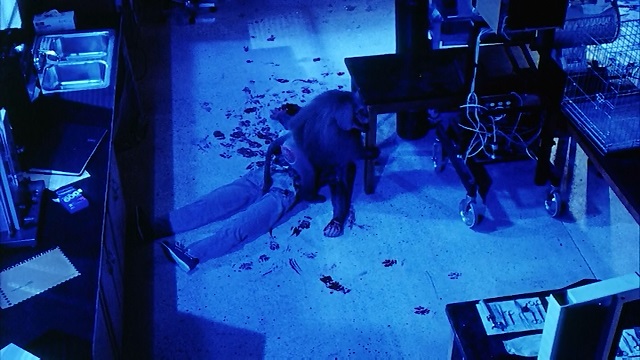

Okay, at this point in the movie, with Shakma now rampaging in earnest, you’re probably asking yourself, Why don’t those still alive just leave? A very legitimate question indeed. Good job, class. Yes, they’re locked inside the building with no access to any phones (-- all locked inside faculty offices), and yes they could probably just break out a window on the ground floor and escape, but this they do not do because, and to their credit, they aren’t sure the others are dead, despite the obvious evidence, and want to drag them to safety before Shakma can do anymore damage.
Which is why we can kinda-sorta forgive Sam for constantly sending his girlfriend out as bait to lure Shakma away while he checks on the bodies. And the only boneheaded move our heroes really make is when they finally switch frequencies on those walkie-talkies and contact Gary, who still thinks they’re playing the Game.


Here,
they don’t immediately warn him about the killer monkey, allowing him
to blunder onto the killing floor, and whose death now allows Shakma
access to the elevator, meaning no floor is safe. (Yes. The monkey can
work an elevator. Yes. I know. We, as a species, are doomed. Well, at
least I think he can, otherwise how in the hell he moved between floors
as the film barrels toward the climax is beyond me and anyone’s guess.
Anyhoo...)
Thus, thinking Shakma is still trapped on level four, Sam and Tracy split up; Sam heads to the top floor to round up Kim while Tracy heads to five to look for Bradley since they never saw his body in the lab, where she runs right into Shakma. And sadly, turns out the women's restroom and a toilet stall makes for a crappy refuge from one determined baboon. Her efforts are valiant, but, nope.
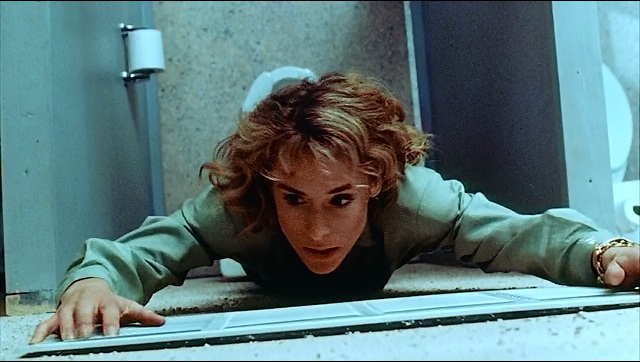


Alas, after Tracy’s death Shakma kinda loses its way as the killer monkey essentially disappears for nearly twenty whole minutes. Here, the film loses focus and all momentum, wasting too much time on the uncomfortable efforts of Kim’s blatant and juvenile efforts to seduce Sam.
Which is then compounded further with her later, and equally futile efforts to draw the attention of Richard’s girlfriend parked outside the building. I swear, we watch her toss every, single, piece, of cutlery, from the faculty lounge out the window. This entire scene is then repeated later with a bunch of ‘magic’ marbles.


When this proves equally fruitless, Kim leaves a note for Sam and heads off to find her brother since Sam couldn’t bring himself to tell her Richard was dead; a terrible and tragic mistake that winds up getting Kim killed, too.
Sam, meanwhile, is looking for Tracy, following a blood trail that eventually leads to her body. This, obviously, hits him pretty hard. He then tracks Kim to the lab and finds her dead, too. And as the last man standing, Sam decides it’s time to settle this, mano a monkeyo, once and for all.

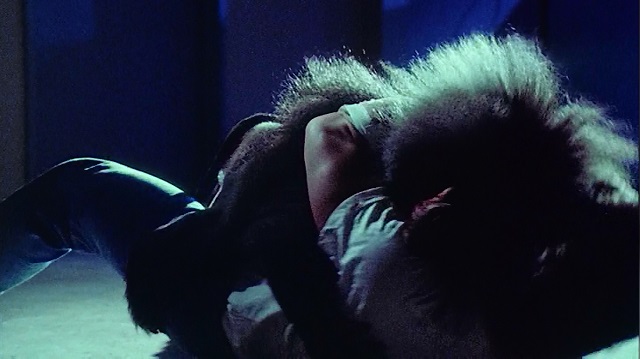
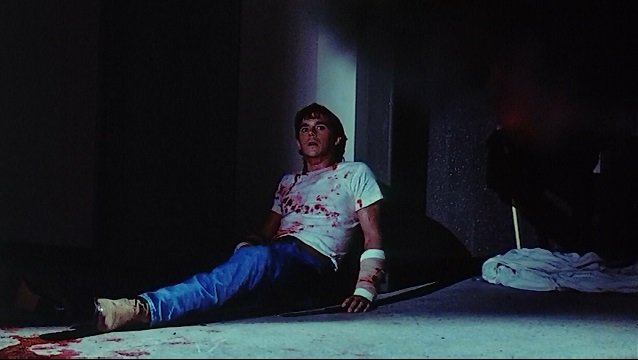
His plan is two fold, but when his first electrical flytrap fails, Shakma pounces and savages Sam pretty good, taking out a good chunk of his neck. But his second trap is actually pretty clever, sadly given away in the trailer.
Using a mirror and the baboon’s own aggression against him, Sam tricks the animal into launching himself into the incinerator, where Shakma is burned alive, and rather gruesomely. (Told you it would all end in fire.)


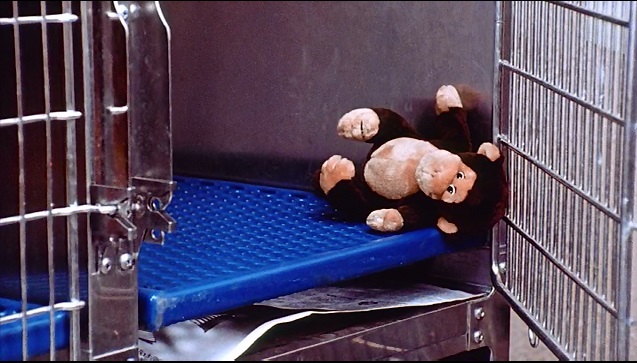
But this appears to be a pyrrhic victory as Sam stumbles into the hall, collapses, and declares, “I win” to a stuffed monkey lying on the floor before he apparently expires, too. Game over. Hooray! Everybody’s dead!
Yeah, whenever I introduce people to Shakma I say it’s a movie where a killer monkey interrupts a live-action game of D'n'D and murders everyone. And when it's over, when everyone turns and stares at me, I say, “What part of the ‘monkey murders everyone’ did you not understand?”


Now, when you combine that downer ending, the poor man's nods to Die Hard (1988) with the high-rise setting, the novelty of a killer monkey, resulting in a nice twist on the usual slasher tropes, I’m honestly surprised Shakma isn’t better known or better remembered than it is.
Bad timing, maybe? The horror genre was drying up theatrically as the 1980s ended, where it languished until Scream (1996) hit and reignited this kind of body count flick. It’s a terribly flawed movie, make no mistake, but I still think there’s enough juice present for a plausible Cult Movie status. And in this day and age of geekdom and LARPing there’s probably a whole, brand new audience for this movie out there that just needs to find it, I’d bet.

In fact, Parks had not one, but two, latter-day slasher flicks in production at the same time: Shakma, and the more traditional The Night Brings Charlie (1990), where a deformed psychopath goes on a killing spree with a pruning saw, which was directed by Tom Logan, whom Parks recruited to co-direct Shakma once he found himself in over-his-head. And while the direction from both men is kinda lackluster, it’s also saddled with a script that requires characters to be THAT stupid from the get-go to make it work. And aside from that dark ending, the film holds no real surprises -- Engle basically fell off the cinematic map after this, his sole output.
But the film is salvaged somewhat by some brilliant sound design by Carl Carden and David C. Williams’ frenzied electronic score. And while the sets are dull and repetitive, there is some outstanding production design by Michael Larson, Eric Gustafson and Terry Alan Meads -- I loved all the trails of bloody paw prints Shakma leaves behind. And there’s some delightful grue make-up effects and faux monkey-prop carnage courtesy of Rick Gonzales, Dan Bedell and Lee Grimes.


The film had a budget of $1.5 million and was shot between January and March of 1990 at the newly christened Universal Studios in Orlando, Florida, which was really trying to establish itself as a major player at the time -- and had just landed Nickelodeon, who pulled up stakes from New York and Philadelphia and relocated to these brand new facilities and launched a whole new era of programming. In fact, one of Shakma’s victims, Robb Edward Morris, had hosted the short-lived Nickelodeon game show, Make the Grade (1989).
The rest of the cast are okay, they’re just not written very well with nothing to do except wander around endlessly and in circles until the monkey shreds them; and for the most part, the audience is eagerly begging for all of them to meet an untimely end. I will say this, though: every single one of them sold the hell out of being attacked and murdered by a stuffed monkey puppet.


Christopher Atkins never really was much of an actor, even back in his Blue Lagoon (1980) and The Pirate Movie (1982) days, but he serves well enough as the nominal hero; even though everything that happens is basically all his fault or an end-result of his blundering. I personally hooked my car to Amanda Wyss, who is so adorable I can’t even even; and whom we all probably remember as Tina Gray in A Nightmare on Elm Street (1984) -- or at least her gravity-defying demise in that film. And always the trooper, Roddy McDowell gives it his all while he spent three whole days to get his part in the can.
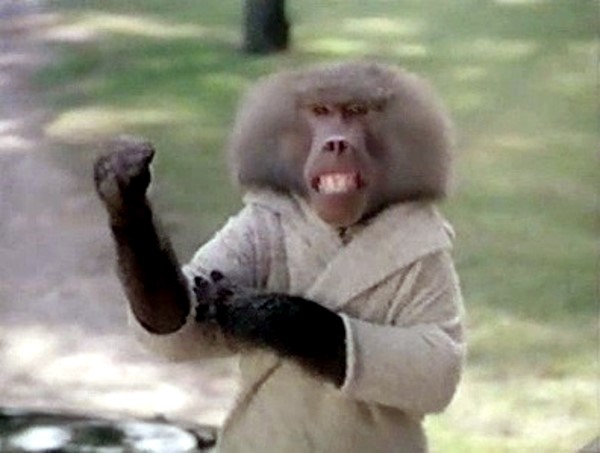
But the best actor in the whole movie is Typhoon the horny baboon, giving one of the most insanely intense performances I have ever seen by an animal. This wasn’t his first feature either, as Typhoon appeared several years earlier as hero Duncan Jax’s trusty sidekick in Earl Owensby’s Indiana Jones knock-offs Unmasking the Idol (1985) and Order of the Black Eagle (1986), where he got to wear a tuxedo, make obscene gestures, fly a glider, and drive a tank. Of COURSE I’m not making that up. He also appeared in David Cronenberg’s remake of The Fly (1986), where he met a rather gruesome demise in one of Seth BrundleFly’s teleportation pods.

I honestly don’t know if Parks tried to latch onto a major studio for distribution and failed, but I do know Shakma did manage to eke out a brief theatrical release through Castle Hill in October of 1990 before it was quickly transferred to VHS tape and shipped off to video stores under Quest’s equally short-lived home-video line, where it’s kind of languished ever since.
The film might even be in the public domain these days as several pan and scan prints can be found streaming on YouTube. But I am happy to report that Code Red has the film out on DVD and BluRay that restores the film to its original aspect ratio. Though for some reason, the commentary track by co-director Logan is only available on the limited edition Bluray. That’s me shrugging again.

As for Parks and Quest Entertainment, well, after Shakma failed to ignite the box-office, when combined with a lot of other bad business decisions, the company filed for protection from its creditors under Chapter 11 of the U.S. Bankruptcy Code.
But Parks managed to shore things up, at least temporarily, by negotiating a merger between Quest and the Salt Lake City based World Information Network Corp, which was formed in 1987 to help sell President Reagan’s Strategic Defense Initiative -- or Star Wars. And all the while, they kept right on trying with releases ranging from Happy Hell Night (1992), to King’s Ransom (1993) to Bikini College (1995). And after that, Parks found himself arrested -- and not for the questionable quality of his films. Sort of.

"He didn't want to make good movies. He wanted to make good money," said Ross Testagrossa, a former acquaintance of Parks, who had served as president of Orlando's Chapter of the Florida Motion Picture and Television Association back in 1992. It was Testagrossa who introduced Parks to John Linde, who wrote the script for After School. Said Linde, who claimed Parks still owed him money, "Here's a guy who was an engineer who wanted to be a movie producer. He didn't have a clue."
And on December 12, 1996, Parks was convicted of conspiracy and fraud for cheating and bilking nearly $3-million out of his investors via a scheme involving the sale of video distributorships. According to an article by Twila Decker (The Orlando Sentinel, March 20, 1997), “Investors paid from $10,000 to $50,000 for a given territory. But they say they were misled about the quality of movies Quest would produce. They also said the company sold the same territories to several people.” And when these investors filed a grievance, this triggered an investigation by the FBI and the Internal Revenue service.


Thus, Parks was also convicted on charges of money laundering and wire and mail fraud. Add it all up and the disgraced producer faced 140-years in prison and fines up to $5-million. He was supposed to receive his sentence in March, 1997, but he sorta disappeared for about 10 days before finally turning himself in. And in the end, Park was sentenced to six years and was ordered to pay $1-million in damages, leaving quite the dubious legacy in independent film production.
As for his best known film, stuck in that nebulous gray area of being not quite horror and not quite schlock, and not really good but also not terrible enough, Shakma is ultimately undone, I think, by its running time. Clocking in at nearly two hours (-- it honestly feels like three), the film is just too damned long and cannot sustain the novelty of the monkey’s rampage and killing spree.


Here, the film fails in editing and suffers terribly from something I like to call Kitchen Sink Syndrome™ -- meaning since they shot the footage they’d best use all of it, pace be damned. That whole fifteen to twenty minutes I mentioned after Tracy died could and should go, and another five to ten minutes snipped here and there and I think you’d have a really lean and mean 80-minute masterpiece of gonzo animal attack cinema instead of the poo-flinging slog we got. I still like Shakma well enough but, man, we really could’ve had something truly unique here.
Originally posted on January 18, 2018, at Micro-Brewed Reviews.

Shakma (1990) Castle Hill Productions :: Quest Entertainment / P: Hugh Parks / D: Hugh Parks, Tom Logan / W: Roger Engle / C: Andrew Bieber / E: Mike Palma / M: David C. Williams / S: Christopher Atkins, Amanda Wyss, Roddy McDowall, Ari Meyers, Robb Edward Morris, Tre Laughlin, Greg Flowers, Typhoon the Baboon


