Showing posts with label Barbara Stanwyck. Show all posts

Sunday, August 7, 2022

Lady of Burlesque (1943)

"I'll tell you what the public wants: Girls!"

Our feature begins long after the opening curtain went up for the evening show at the old Opera House, where the viewer promptly gets a front row seat for the current act; and after combining the skimpy outfits with the wild gesticulating by the all-girl chorus filling them out, it doesn't take a viewer long (-- if the title hadn't already given it away, 'natch --) to realize S.B. Foss, owner and proprietor, is running a burlesque show.

But the action doesn't really begin until we move backstage and into the overcrowded dressing rooms, where this well-oiled machine of a company is slipping a few gears as the following acts fritter and frack around, preparing to go on stage next. Why?

Well, see, tonight is also the premiere of Foss' new headlining act, Dixie Daisy (Stanwyck), who is currently avoiding both the claws of a few demoted co-stars and the romantic overtures of swifty Biff Brannigan (O'Shea), one of the troupe’s stock comedians. And as several more rancorous subplots and highly volatile three-cornered love affairs reveal themselves backstage, Daisy takes the front stage by storm and knocks 'em dead with a red-hot rendition of her signature song, "Take it Off the E-String, Play it On the G-String."

But the evening quickly unravels during a later number, a comedic sketch with Biff and Daisy, when the police start pushing their way into the theater. Now normally, when a vice raid is sniffed out, a warning light is flashed backstage so the players can evacuate without getting pinched for public indecency; but this time the alarm failed due to sabotage. And during the resultant melee, once the cops make their move and everyone scatters for the nearest exit, Daisy is caught alone in the darkened basement, where someone reaches out of the shadows, seizes her by the throat, and tries to strangle her...

Not quite film noir, not quite a comedy, and not quite a musical, but more of a musical comedy noir, the wild and rambunctious Lady of Burlesque (1943) was based on an even wilder and more rambunctious mystery novel written by the famed ecdysiast, Gypsy Rose Lee.

Born Rose Louise Hovick in 1911 (-- maybe, more on this in a sec), and referred to by her middle-name, Louise Hovick began her showbiz career early as a singer and dancer in vaudeville, serving as a second banana to her little sister, June Hovick, who headlined the act. Known as the “Tiniest Toe Dancer in the World,” Baby June was a hit all over the circuit and had even appeared in a couple of Hal Roach shorts -- On the Jump (1918), Hey There (1918), crying for the camera whenever their overbearing mother, Rose Thompson Hovick, told her the family dog had died.

Louise and June Hovick.

The devious and slightly demented elder Hovick also had several forged birth certificates for her children to make them old enough to avoid any child labor laws or young enough to qualify for cheaper travel fare, whichever was applicable. And things got so confusing that neither sibling knew for sure when their birthday was -- or even how old they really were!

But June would break away from her mother in late 1928 after an engagement at the Jayhawk Theater in Topeka, Kansas, eloping with Bobby Reed, one of the dancers from their troupe. Her mother raised all kinds of hell over this, having the boy arrested since her daughter was underage according to one of those birth certificates; and even attempted to assassinate Reed at the police station -- only she had forgotten to disengage the safety on her pistol and wound up just assaulting him instead. Undaunted, the two lovebirds still married and June officially left the act and struck out on her own. And while the marriage didn’t last, once out from under Mother Rose’s oppressive thumb, her career flourished both on Broadway and in Hollywood.

Adopting the name June Havoc, she had a breakout performance in 1940 as Gladys Bumps in the Rodgers and Hart musical, Pal Joey, co-starring with Gene Kelly and Van Johnson. All three then transitioned to Hollywood, where Havoc would star in several musicals -- Sing Your Worries Away (1942), Red, Hot and Blue (1949), screwball comedies -- Hi Diddle Diddle (1943), Brewster's Millions (1945), and dramatic roles -- Gentlemen’s Agreement (1947), Chicago Deadline (1949), splitting time between stage and screen.

As for Rose and Louise, well, the act kinda fell apart after June left. Around this same time, Louise realized there was more money to be made working in burlesque than vaudeville. And as the legend goes, her act solidified into something truly special when a shoulder strap on her gown snapped ahead of schedule and, despite her best efforts, the gown wound up on the floor around her ankles to the approving roar of the audience with each failed effort to keep herself covered.

Making this the focus of her act, Louise officially adopted the stage name of Gypsy Rose Lee and soon earned herself quite the reputation as a “high class” stripper due to her acid-tongued commentary, humorous recitations, and a casual stripping style -- which put the stress on the “tease” in striptease instead of the usual bump ‘n’ grind, earning herself a spot in The Ziegfeld Follies of 1936 and revitalized the art of burlesque itself.

As columnist Dale Harrison put it (Allentown Morning Call, December 27, 1936), “Burlesque hasn’t been itself for more than a decade. The movies, the Scandals-Follies-Vanities type of stage show, the radio, and the Depression were a quartet of competition that had the girlie shows groggy … It remained for Gypsy Rose Lee -- a burlesquer by desperation rather than intent -- to lift “peeling” to a high art. And when she transferred her disrobing from 32nd Street to Broadway, it ceased to be burlesque and became big league entertainment."

Still, at the time, you could only take so much off before you got arrested. And after a successful four year run at Minsky's Burlesque Theater in New York, where she was frequently arrested in many a vice raid -- later translated to film, somewhat, by William Friedken and Norman Lear in The Night They Raided Minskys (1968), Lee went legit and gave Hollywood a shot in 1937, coaxed out west by Darryl Zanuck and 20th Century Fox.

Unlike her sister, this transition did not go well at all. Between 1937 and 1938, Lee, credited as Louise Hovick, appeared in five films, starting with You Can’t Have Everything (1937) and ending with My Lucky Star (1938), all of which were critically panned. She would later star as herself in Stage Door Canteen (1943), performing her act for the troops, and then teamed-up with Anita Ekberg as a couple of ‘exotic dancers’ in the psychological thriller, Screaming Mimi (1958) -- later remade by Dario Argento as The Bird with the Crystal Plumage (1970).

Now, the only film of Gypsy Rose Lee that I’ve actually seen was Belle of the Yukon (1944), a musical comedy western co-starring Randolph Scott and Dinah Shore. And while I didn’t think the film nor her performance was bad by any means, it was definitely odd and marred a bit by her constantly pursed lips and bizarre elocution, as if she was still doing her act.

Thus, as her acting career floundered and failed to find any real footing except for, essentially, playing herself, in 1941, Lee put pen to paper and wrote The G-String Murders, a semi-autobiographical whiz-banger of a whodunit that takes place backstage at a burlesque theater, with Lee serving as the de-facto narratrix to help the reader navigate through these uncharted literary waters.

Hunt Stromberg, meanwhile, was MGM's golden boy producer in the 1930s, who had successfully imported Greta Garbo, oversaw all of Jean Harlow's MGM films before her tragic death, and made a star out of Joan Crawford; he also brought together Nelson Eddy and Jeanette MacDonald for their musical extravaganzas, and paid William Powell and Myrna Loy's bar tab for the first four features of The Thin Man (1934-1941) franchise. But by 1941, things had soured so badly between Stromberg and MGM’s head lout, Louis B. Mayer, that he was allowed to walk away from an insanely lucrative contract to try his hand as an independent producer. Something Mayer eagerly let him do, feeling Stromberg would fall flat on his face without him.

Quickly snatched up by the Society of Independent Motion Picture Producers -- later morphing into United Artists, Stromberg tapped Lee's novel to be his first feature post-MGM. Now, according to The Hollywood Reporter (October 15, 1941), this would be the second attempt to bring Lee’s novel to the big screen. It seems David O. Selznick had first crack at it, who was also in business with United Artists at the time, optioning the rights and assigning producer John Houseman to adapt the screenplay with Joseph Cotten under consideration for the role of Brannigan. But at some point, Selznick lost interest and Stromberg took over.

Hunt Stromberg (third from left) on the set of The Thin Man.

No matter who produced it, most Hollywood insiders at the time felt adapting The G-String Murders to be an insane and futile notion; and speaking frankly, with the novel's more, well ... saucier elements, I don't think this was something Selznick nor Stromberg could’ve ever even attempted at any of the major studios.

According to Thomas Doherty’s book, Hollywood's Censor: Joseph I. Breen and the Production Code Administration, while reviewing the script, Breen was already in a dither, saying, "We are concerned about the prominent use of the object known as the 'G-String' as the murder weapon. It is our impression that the use of this extremely intimate female garment will be considered offensive.” The censors also objected to a routine involving a “Pickle Persuader” but both it and the lethal G-String stayed in the film. There’s also hints that one of the players had an abortion that leads to a blackmailing scheme that also managed to stay in. However, a subplot concerning the stripper’s dressing room getting a new toilet was found objectionable, got nixed, and was replaced with getting a new sink.

Thus, faced with these kinds of restrictions, first time scriptwriter James Gunn (-- no relation to the James Gunn you're probably thinking of --) had to subvert many of the novel's grinds ‘n’ bumps. And to his credit, Gunn still managed to sneak quite a bit past Breen and his hatchet men. I love the bit where Iris Adrian’s Gee-Gee “The Platinum Panic” Graham rips into the others backstage after one of the many catfights, saying, "The next time you girls pull a free-for-all, don’t pull it during my act. Y’know, it’s tough enough doing something artistic for those lugs out there without you [two] calling each other by your rightful names!"

Of course, one of Gunn's alterations was changing the protagonist from Gypsy Rose to Dixie Daisy. And to fill that G-String, Barbara Stanwyck does an amazing job of bringing the heat and the snark -- and she looks absolutely fabulous in those Edith Head designed dresses slit to her nether regions. And when she's dancing, evidenced by her dance-off with co-star Pinky Lee, the star absolutely excels.

As for her singing, well, evidenced here and in Howard Hawks' Ball of Fire (1941), even though Stanwyck lacked the chops of a classical singer her performance definitely grows on you. It's kinda like Ida Lupino's lounge act in Road House (1948); at first encounter, it sounds kinda shaky and teetering toward honestly not very good; but with each passing verse, as both starlets make the songs their own, all doubts are soon flushed. A minor quibble anyway, because the rest of the package drops a payload that easily obliterates any and all concerns.

Speaking of obliterating, as good as Ms. Stanwyck is, the film was nearly stolen out from under her by co-star Michael O'Shea. O'Shea was a revelation to me, here. I had only seen his work once before, as the grizzled First Sergeant who gets stuck in the frozen minefield in Sam Fuller's harrowing Korean War drama, Fixed Bayonets (1951); and I didn't even realize it was the same guy until checking out his credits.

Like with the Hovicks, O’Shea had done his time in the trenches, working barnstorming shows, vaudeville, burlesque, and radio before he broke out in the Broadway smash hit, Eve of St. Mark, and was then imported to Hollywood by Stromberg to fill the vacuum left by several big name actors signing up for the war effort. Here, he's hysterical as the wise-ass comedian and Daisy's punching bag; and the screen just crackles whenever Biff and Daisy trade barbs and rebukes, clobbering each other over the head with one loaded double-entendre after another as the bodies keep piling-up around them.

See, Daisy is initially saved during the raid by the timely arrival of a police matron, who scared the killer off in the basement. Unsure if the villain was really after her -- it was dark down there after all, and when combining the events with the sabotage on the early warning system, Daisy suspects that someone was just trying to scare her off in an effort to shut down the show.

But this theory takes a backseat when Lolita Laverne (Faust) is caught canoodling with the show's straight-man (Fenton), who then has a horrid dust-up with her heel of a boyfriend (Mohr), a gangster saloon keeper; an altercation so violent the act on stage has to switch to a song to try and drown them out (-- one of the film's best handled scenes). And when Laverne later turns up dead, strangled by her own G-String, a lot of the physical evidence points to Daisy being the killer.

Biff, of course, does his best to throw suspicion elsewhere to save his girl, but winds up in trouble himself when the missing murder weapon is found planted in his pocket. And as a wily police inspector (Dingle) tries to sort through all the unruly suspects and motives, things take an even more sinister turn when another stripper, Princess Noveena (Bachelor), the least-popular person in the whole show, winds up dead, too, strangled in the exact same fashion.

Before any more bodies turn up, the show is officially shut down. And while a nervous Daisy feels like a loose-end that needs to be knotted-off, together with Biff, these amateur sleuths unravel a mystery plot that I don't think even Raymond Chandler could’ve cooked-up on his worst three-day bender:

Turns out the first victim was killed twice; first with poison, and then strangled before the poison could take effect. The first victim also knew Noveena's secret: an affair with the boss that culminated with an abortion south of the border, which allowed her to blackmail Foss (Bromberg) into demoting Daisy and making her into the new headliner. The first victim had also withdrawn a large sum of money before she died. Money that wound-up in the straight-man's pocket, who also most likely poisoned her.

Now, despite all of this damning evidence, all the physical clues still point to Daisy as the killer of both women. But who really dunit? The jealous ex-boyfriend? The straight-man? The straight-man's estranged wife? The black-mailed boss? And don't discount any of the seedier backstage hands, holdovers from the theater's Golden Age, whose disdain for burlesque performers is palpable. Or perhaps Daisy was right in the first place: Maybe the motive for the killing was to simply stop the show? Who benefits then? Or maybe, it's a combination of all of the above.

Even though everyone scoffed at Stromberg's folly, Lady of Burlesque went over very well with audiences in 1943 and raked it in at the box-office. Behind the camera, Stromberg brought William Wellman with him from MGM. And 'Wild Bill' Wellman was a pretty ideal choice to direct this picture, I think, because he always gave his leading ladies free rein to dump the usual debutante trappings and be their natural, hard-drinking, rough-talking selves -- see also his efforts in Westward the Women (1951).

Wellman was always so good at capturing a sense of camaraderie in his war pictures -- The Story of G.I. Joe (1945), Battleground (1949), where every person -- the joker, the newbie, the yokel, the asshole etc. -- were all vital in making the squad tick; and turns out the same holds true when he's dealing with dancers and strippers and comedians.

However, Lady of Burlesque does kinda fall flat during the musical numbers, where the director's usually fluid style turns way too static, with lots of long shots, as if to make the audience part of the onscreen theater audience -- an experiment that ultimately backfires, but it was part of his overall theme. (More on that in a sec.) This is remedied, somewhat, by inserts of shots from the side-stages, where we see the act in the background or foreground framed by the more frantic behind the scenes action to break-up the monotony. And I do love the opening dance number, where you can easily tell who's new to the chorus and who's a veteran by the level of their enthusiasm.

But the film really isn't about the show itself, or even the murders, really, but the thunder and chaos of what happens backstage and the interaction of the players to make the show work four times a day. (It's like a combination of the Keystone Cops and The Muppet Show.) Here, Wellman excels, too, where his usual, voyeuristic key-hole camera really doesn't feel like we're spying on the proceedings but are part of the proceedings, giving you a sense of total immersion; and so, yes, even making the audience part of this overall camaraderie.

Over the years since its first publication, many have contended that Lee's source novel for Lady of Burlesque was actually ghost-written by Craig Rice -- an alias for Georgiana Ann Craig, who was gaining notoriety for her John J. Malone mysteries around the same time, which combined the usual hard-boiled knocks with some overtly comedic overtones, resulting in something totally surreal (-- and, according to most reports, highly gruesome). But this controversy appears to have been quelled lately, with corroborating evidence in the form of correspondence between Lee and Craig, who were roommates at the time, and George Davis, an editor for Harper's Weekly, which shows the majority of the story came from Lee with a few suggestions and touch-ups coming from the others.

The author then followed that up with another murder mystery, Mother Finds a Body -- a direct sequel that reunited most of the surviving characters from the first novel -- which was published in 1942, but then Lee was immediately hit with a lawsuit over breech of contract. For, according to the plaintiff, Dorothy Wheelock, an associate editor for Harper’s Weekly, alleged that she and Lee had entered an “oral agreement” back in 1940 before the publication of The G-String Murders, which said they would “collaborate on a joint venture involving the conception, construction, development, writing and exploitation of a literary work with a burlesque background.” This verbal contract also called for a 50/50 split of the profits on the same once it sold.

But after Wheelock claimed to have found a publisher for their book, then still in progress, Lee allegedly backed out of the deal around November, 1940, handing over all the materials they had worked on together. Wheelock then took these materials and wrote her own book, which failed to find a publisher. Wheelock then claimed Lee’s published novels plagiarized their shared work. Lee, of course, denied this until the case was eventually settled out of court -- quite possibly with an assist from Stromberg and United Artists to clear up the movie rights.

On the personal side, when she first moved out to Hollywood in 1937, Zanuck insisted Lee get married to help mollify audiences who were aware of her former profession and looked down upon it. But her marriage to Robert Mizzy was destined to end by 1941. Lee then moved back to New York City, where she had an affair with producer Michael Todd, and appeared in his 1942 musical review, Star and Garter. A year later, Todd would produce a play Lee had written called The Naked Genius, starring Lee and Joan Blondell, but it barely ran for a month -- though the production was later adapted by Fox as Doll Face (1945) -- initially as a vehicle for Carol Landis, who backed-out at the last minute and was replaced by Vivian Blaine.

Meantime, Lee would marry again in 1942 to William Kirkland, and then divorced him two years later. And then married again in 1948 to Julio de Diego, which also ended in divorce. Somewhere in the middle of all of that, Lee had an affair with director Otto Preminger, which resulted in their son, Erik Lee Preminger.

Lee, Robert Mizzy, and Mother Rose (circa 1937).

All the while both Lee and her sister supported their roustabout mother, who opened a boarding house for women in the West End of Manhattan in the mid-1930s on their dime. Scandal soon followed when one of Mother Rose’s tenants, Genevieve Augustine, turned up dead. Rumors soon spread that Rose and Genevieve were lovers, and Rose killed Augustine over a rapacious spat when the latter allegedly started flirting with her daughter, Lee. However, the incident was officially ruled a suicide. Mother Rose would continue to demand money from her estranged daughters until her death in 1954 when she succumbed to colon cancer.

After her mother’s death, Lee once more put pen to paper -- this time, a memoir about her mother and her career; something she felt she could only do after Rose had died without getting sued. Published in 1957, Gypsy: A Memoir would go on to inspire Julie Styne, Stephen Sondheim and Arthur Lauents to adapt it into the musical, Gypsy, which debuted in 1959, starring Ethel Merman as Rose, Sandra Church as Lee, and Lane Bradbury as Baby June. The show was a smash hit and ran for nearly two years and 701 shows in its initial run and earned eight Tony Award nominations. But it somewhat notoriously failed to win any, getting wiped out by The Sound of Music -- but it did manage to land a Grammy for Best Musical Theater Album. The show was later adapted to film by Warner Bros. in 1962, with Rosalind Russell taking over as Rose and Natalie Wood starring as Lee.

Initially, Havoc wasn’t thrilled with her portrayal in any of these iterations but she basically kept quiet and didn’t raise too much of a stink, allowing her sister access to the royalties without any obstructions -- for a stipend. And Havoc would go on to write her own version of events in two autobiographies, Early Havoc and More Havoc.

In the mid-1960s, Lee served as host for The Gypsy Rose Lee Show, a daytime talk show out of KGO-TV, San Francisco, which ran from 1965 through 1968. She would continue to appear in films, mostly bit parts in things like The Stripper (1963) and The Trouble with Angels (1966). She was also a semi-regular panelist on The Hollywood Squares in 1969. Her last film appearance would be in the Made for TV Movie, The Over-the-Hill Gang (1969), a western, co-starring Walter Brennan, Pat O’Brien and Chill Wills. She would pass away a year later in 1970 due to complications from lung cancer. She was only 59.

“How does one become a striptease artist?” exposited Gypsy Rose Lee during her appearance on the TV-quiz show, What’s My Line? (May 31, 1959). “You take a bag full of marbles and put them in your mouth. And then you take them out, one a day, until you’ve lost all your marbles and then you become a stripteaser.”

Now, for those of you under the age of 40, having "lost your marbles" was a popular euphemism for euphorically embracing a not-well-thought-out notion or decision. And I think it was that kind of self-deprecating humor that is one of the more cherished legacies of Gypsy Rose Lee. And while overshadowed a bit by the more personal Gypsy, I think the rough 'n' tumble Lady of Burlesque should also be cherished as such, too. 

And if you'd like to find out who really dunit, the film’s in the public domain and available for free on many streaming services or dirt-cheap on a number of DVDs (-- the best version I've found was on Amazon Prime under the banner of Moving Pictures Archive), which, alas, is too much of a good thing because a flick this great, with that kind of pedigree, with such a full frontal boom-boom performances by Stanwyck and O’Shea, deserves the full restoration treatment. You listening, Criterion?

Thus, regardless of how bad a print you find for Lady of Burlesque, stick it out. Because you're in for a real crackerjack mystery musical comedy humdinger of a whodunit with lots and lots of mayhem and eye-candy that can sway any and all cinematic curmudgeons. Trust me.

Originally published on July 16, 2013, at Micro-Brewed Reviews.

Lady of Burlesque (1943) Hunt Stromberg Productions :: United Artists / P: Hunt Stromberg / D: William A. Wellman / W: James Gunn, Gypsy Rose Lee (novel) / C: Robert De Grasse / E: James E. Newcom / M: Arthur Lange / S: Barbara Stanwyck, Michael O'Shea, Charles Dingle, Iris Adrian, J. Edward Bromberg, Victoria Faust, Frank Fenton, Stephanie Bachelor, Pinky Lee, Gerald Mohr

Wednesday, July 28, 2021

Roustabout (1964)


"Lets get one thing straight. 
"This is not a circus. This, is a carnival."

We open in a place called Mother’s Tea Room, which is a bit of a purposeful misnomer, I'd wager -- if I’m reading the film’s tea leaves right, as a waitress sits and knowingly serves alcohol to a group of under-age college co-eds (-- among them Raquel Welch and Norm Grabowski), and then instructs them on what to do with their drinks when a certain light over the bar starts flashing, meaning a raid is imminent. And then this ersatz speakeasy really gets to rollin’ when the owner chases the current act offstage and introduces the next one, Charlie Rogers. 

Now, here, we quickly deduce that Rogers (Presley) is from the wrong side of the tracks, has a fairly sizable chip on his shoulder, and a very short fuse when his first number, “Poison Ivy League,” really takes the piss out of the unruly, privileged "college boys" he sees seated before him. And when you couple that vibe with the fact he also brazenly hit on their girlfriends between each verse, a trio of collegians decide it's time to knock this smart-mouthed singer down a peg or two.

Easily goading their hot-tempered target into a fight out in the parking lot, at three against one, these odds may seem unfair but Rogers quickly breaks out his mad karate skills and easily dispatches all of his assailants, seriously injuring one of them. Alas, sensing trouble, that waitress, Marge (Staley), had called the cops, who take in the carnage and then take Rogers into custody. 

After spending the night in the clink, Marge pays his fine and bails him out in the morning. Seems she has fallen hard for Rogers and is trying to set the hook in deep; but our boy ain’t interested in being tied down or beholden to anyone. “Just because you bailed me out doesn’t mean you own me,” says Rogers, who punctuates this point by hopping on his motorcycle and leaving poor Marge in the dust with nary a backward glance.

Thus and so, it’s time for our aimless drifter to once more move on, who dons his leathers, straps all of his worldly possessions onto his bike, and then hits the open road, where he spontaneously bursts into the song, “Wheels on My Heels.” Now, when this song peters out, Rogers comes upon a trio of people motoring along in a jeep. Spotting a pretty girl riding in the back, our wayward lothario immediately makes a pass at her -- all at about 50mph. 

But the girl's belligerent father, Joe Lean (Ericson), doesn't like this greaser making the goo-goo on his little girl, Cathy (Freeman), and promptly runs the motorcyclist off the road in a fit of temper, much to the consternation of his daughter and his second passenger, his boss, Maggie Morgan (Stanwyck).

Luckily, Rogers isn’t seriously injured. His bike on the other hand is nearly totaled. And by way of an apology, Maggie not only offers to pay for all the damages, including replacing his busted guitar, but also gives this handsome stranger a job as a temporary roustabout for her carnival in spite of Joe Lean’s vehement protests. Rogers accepts, mostly to piss Joe off, but makes it perfectly clear he will only stick around long enough for his bike to be repaired and then he’s gonesville.

With that settled, Rogers quickly gets to work by first learning the difference between a >circus< and >>carnival<< and the Secret Code of Carnies (-- which is very similar to Ape Law from The Planet of the Apes (1968) when you really get right down to it). He also quickly ingratiates himself to his fellow roustabouts, putting rides together, and the rehearsing performers along the midway (-- including Billy Barty and Richard Kiel), picking up the lingo as he goes, learning the tricks of the trade, and avoiding both Joe Lean and a certain grab-fanny fortune teller (Langdon) as much as possible. In fact, he’s adapted so well Maggie's convinced the carnie sawdust has already infected his veins so deeply he’ll soon sign on permanently. 

But Rogers still insists he’ll be leaving as soon as the parts come in for his bike. (About a week.) Meantime, he also works hard to charm Cathy; but her constantly cock-blocking father and her dedication to the Carnie Life seems to always get in the way. And on top of all that, the carnival itself is in some serious trouble.

Under the financial pressure of a recent lawsuit and personal injury settlement, whose root cause was a malfunctioning ride that was under Joe Lean’s direct supervision, who was too drunk to see that it wasn’t stitched together properly, Maggie is currently way behind on the loan payments to keep her operation going. Of course, this chain of events is what set Joe off on his current self-destructive, bourbon-fueled rage spiral despite Maggie’s assurances that it's all in the past and he needs to move on. And she is willing to help him with this, if he’ll let her. 

But all assurances aside, with foreclosure imminent, this one-lung operation is currently on its last leg. And only a miracle, like, say, oh, I don’t know, maybe if Rogers, in his effort to get a shot at Cathy, suddenly bursts into song on several occasions as he serenades her down the midway, drawing a sizable crowd in his wake, will finally turn things around...

After the middlin’ box-office and critical panning of both Flaming Star (1960) and Wild in the Country (1961), Colonel Tom Parker, manager, technical adviser, huckster, chiseler, and grifter extraordinaire, was able to use these back-to-back disappointments to convince his top client and massive cash-cow that it was obvious nobody wanted to see him act as another character in a dramatic role, and only wanted to see him be, well, Elvis Presley. And in Parker’s defense, the numbers backed him up -- at least to a certain degree. The musical comedy G.I Blues (1960) had raked in $4.3 million while Wild in the Country, a drama, brought in $2.7 million and Flaming Star, a western, barely broke over $2 million. 

Thus, from there, for all intents and purposes, with one notable exception that we’ll be addressing in a second, Presley’s chance at a legit acting career was in trouble as he officially entered the Travelogue or Action-Man phase of his Hollywood journey, where he would basically play himself plugged into different playsets with the appropriate accessory pack over and over and over again; be it a boxer in Kid Galahad (1962), a Sheriff in Follow that Dream (1962), or, to get really meta, playing himself as a movie star based on himself in Harum Scarum (1965).

Screenwriter Allan Weiss was responsible for the majority of the scripts during this transitional period -- Blue Hawaii (1961), Girls! Girls! Girls! (1962), Fun in Acapulco (1963), and cemented the formula of slapstick, traveling-matte shenanigans, and a song every seven minutes. Quick and cheap and all according to producer Hal Wallis’s specifications. “Wallis [purposefully] kept the screenplays shallow,” said Weiss in a later interview for Peter Guralnick’s exhaustive, two volume biography on Presley, Last Train to Memphis: The Making of Elvis Presley and Careless Love: The Unmaking of Elvis Presley. “I was asked to create a believable framework for twelve songs and lots of girls” and not much else.

And while these films didn’t amount to much critically speaking they were still making a ton of money for both Parker and his client. At the time, Presley was being paid $200,000 per picture upfront plus 50% of the profits -- netting them about a half million per movie, of which Parker, as his manager, received half. Now, that back-half amount only counted what profits were left after all other production and advertising costs were recouped by the studio first. And so, Parker was constantly negotiating with several other Hollywood studios for a new contract, seeking a million dollar payday per-picture deal upfront. And until that deal was secured, Parker went out of his way to keep production costs down by any means necessary to reap all he could off the back-end of that deal

Of course, Wallis was the one who first imported Presley into motion pictures and inked him to that first contract for Paramount with Love Me Tender (1956), but he allowed Parker to loan Presley out to other studios as well -- mostly to let Parker be someone else's problem for awhile, including United Artists and MGM, which netted audiences It Happened at the World’s Fair (1963) and Viva Las Vegas (1964), which proved both a critical and commercial success -- in fact, it would be Presley’s highest grossing picture to date.

Now, Parker hated Viva Las Vegas with a passion for myriad and mostly petty reasons. Sure, producer Jack Cummings and director George Sydney had run circles around their “technical adviser” during the production, ignoring all his constant demands and meddling over how Sydney was favoring Presley’s co-star, Ann-Margret, too much and was allowing her to steal the movie. But the real reason Parker was so apoplectic over the production was all the money Cummings and Sydney and the studio were lavishly “wasting” on Viva Las Vegas, which went way over its allotted shooting schedule, and went way, way over budget, and cut way, way, way too much into Parker’s share of the profits.

Not wanting something like this to ever happen again, and still owing MGM two more pictures, ever the mercenary, Parker quickly struck a deal with Sam Katzman’s Four Leaf Productions to produce Kissin Cousins (1964) and Harum Scarum for MGM to distribute. Katzman and Parker were of like minds when it came to filmmaking: quick and cheap and done in ten days or less. And in Katzman’s case, sometimes five days or less. From there, all you gotta do is do the crooked math. Viva Las Vegas was an eleven week shoot with a budget estimated just south of $2 million. Kissin’ Cousins was completed in just 15-days on a budget of $800,000 -- over half of which went to Parker and Presley upfront. Thus and so, even though Viva Las Vegas technically made more money, Kissin’ Cousins made more of a profit for Parker first and Presley second. And to add even more insult to injury, Kissin’ Cousins was shot after Viva Las Vegas had wrapped but still beat it into theaters.

With that, Parker had successfully navigated his way around this perceived bump in the road. And while he was satisfied that things were back on track for their next scheduled feature with Wallis and Paramount -- Roustabout (1964), the master schemer was also starting to openly worry that he and Presley might no longer be on the same page.

On a personal level, at the time, Presley was kind of in a bad place. His affair with Ann-Margret had just both blown up in the papers and then subsequently imploded, which was followed by a massive fight with Priscilla Beaulieu, hidden away back in Graceland, over this infidelity. This would explain why Presley had been basically hiding out in Las Vegas for several weeks before he reported to the RCA Studios to record the soundtrack for Roustabout, where, according to an apocryphal story, when he requested that his usual back-up singers, The Jordanaires, accompany him on the “Wheels on My Heels” track, this was shot down because it wouldn’t mesh with the narrative of him riding alone on a motorcycle. Where would they come from (on film), they asked. To which Presley snapped back, “The same damned place as the band!”

"Who was that fast-talking hillbilly sonofabitch that nobody can understand?” Presley would later eulogize over his derailed movie career. “One day he's singing to a dog, then to a car, then to a cow. They're all the same damned movie with that Southerner just singing to something different." But even before the end, Presley was becoming disillusioned with acting and Parker's choice of scripts. Sensing this as well, to appease his client, Parker told Wallis that Roustabout needed to be a throwback picture and the main character needed to be a little wilder, a little rowdier, in an attempt to recreate the rebellious spark of Presley’s movies of the 1950s -- Loving You (1957), Jailhouse Rock (1957) and King Creole (1958). But, as the website Cinema Romantico rightly points out, “Whereas that spark in the ‘50s was more a product of youthful swagger, in Roustabout it is brewed with anger.”

The production was actually first announced back in May of 1961, then under the working title, Right This Way, Folks; and as an ex-carnie himself, I’m sure it was a concept that was dear to Col. Parker’s most grizzled heart. And once it was back on the slate, Parker would shoot off dozens of memos to Wallis about how the carnie workers should be treated with respect on film, focusing on the pride they took in their work. As for Wallis, he had his own concerns with the picture, feeling his star was looking a little “pudgy, soft and jowly.” His character was supposed to be a “rough, tough, hard-hitting guy” after all. And something would have to be done about his hair, which Wallis thought looked atrocious in Viva Las Vegas, feeling it came off as a bad wig; and so, the producer demanded the studio take care of Presley’s trademark dye-job and pompadour for the duration of the Roustabout shoot. Parker agreed, and so would Presley.

“If you ain’t tough in this world, baby, you get squashed,” says Rogers, establishing early on that his character has little patience or room in his psychological make-up for any sentiment. Anthony Lawrence would join Allan Weiss as co-screenwriter on Roustabout, who set to work making those required changes, explaining away why Charlie Rogers comes off as a bit of an indifferent, self-serving dick, which the film ultimately fails to get to the heart of and unravel -- a tactical error that would completely torpedo the ending. And it should be noted that, as presented this way, Rogers’ interest in Cathy cannot be interpreted as being romantically motivated at all; and therefore, it’s nothing more than a blitzkrieg attempt to woo the girl into knocking-boots behind the hot-dog stand before this pathological loner once more moves on.

Sure, this hardened veneer breaks down a little when Cathy subs in at the dunk tank where her father works the crowd on a chilly night, and is sent plunging into the frigid water by a ringer from the local baseball team, who seems hellbent on drowning the poor girl. And when Joe gets caught trying to rig the game to stop the next plunge in spite of another bullseye, the ball-tosser threatens to call a cop over these shenanigans. And so, all he can do is watch helplessly as Cathy, who assures she’s fine when it's obvious she’s not, is sent plunging into the tank again.

Here, Rogers finally steps in on Cathy’s behalf, pushes Joe aside, takes over the stand, and physically restrains the pitcher from hitting the target. It soon comes to blows, and the booth is destroyed in the resulting melee. When it's finally over, calmer heads prevail thanks to Maggie until the customer can’t find his wallet, left on the counter, who then accuses Joe of stealing it during the ruckus. Thus, Joe gets arrested and is hauled off to jail. And with his biggest obstacle finally out of the way, Rogers, in not the wisest of moves, takes this opportunity for another shot at Cathy, which goes about as well as you’d think under the circumstances.

Meanwhile, Maggie runs into Harry Carver (Buttram), a rival carnival owner, who’s anxious to pick the bones of her show once it finally goes under and then fold them into his own -- especially a certain singer he’s heard about that’s been drawing crowds like bears to honey. But the demise of her carnival has been greatly exaggerated, says Maggie, who claims she’s about to sign on Rogers for the long haul and then all her financial problems will be over.

Meantime, after having his own chat with Carver, and rejecting an offer to come work for him for more money, Rogers searches what’s left of the dunk-tank booth in an effort to make amends with Cathy and eventually finds the lost wallet where it fell unseen, hung up in the bunting. And while this discovery would exonerate Joe immediately, Rogers decides to let the old man cool his heels for the night in jail, letting him sleep off his multiple-week bender, and get his act together, for Maggie’s sake, I think. Again, the film is a little unclear on the motivations, here.

The following morning, a service truck drops off Rogers’ repaired motorcycle just in time to deliver that recovered wallet to the cops and spring Joe. But! Due to some rather dubious circumstances, this is all postponed again when he’s goaded into riding one of the stunt-bikes in the centrifugal Wall of Death attraction. Here, Joe’s wallet flops out of his pocket as he throttles down when Maggie and Cathy demand he stops this nonsense before their star attraction gets hurt, which is then found and given to Cathy. And while Rogers admits he found the wallet the night before and tries to explain his rationale for the delay in turning it in, his actions were a clear violation of the Carnie Code and he is immediately ostracized. 

This also earns him a rightful close encounter with Joe’s fist after Maggie gets him released. With that, Rogers packs up, leaves, and ultimately jumps shows, signing on with Carver, who funnels a lot of money to his new star and his production numbers (-- “Big Love, Big Heartache” wasn’t bad, but “Little Egypt” is the absolute worst). Of course, with Rogers no longer around, the crowds start drying up for Maggie as the weeks passed and now she’s officially being foreclosed on come tomorrow. When Cathy asks if there is anything she can do, Maggie says she already knows the answer to that ... Uh, movie? No. No she really doesn’t. 

And that’s why here, right here, is where Roustabout completely falls flat on its face as Cathy goes to see Rogers perform at the rival show. He spots her in the crowd, they connect on some cosmic level or … something, because now they're magically in love with each other. At least that’s how we’re forced to read it once the song wraps, as Rogers not only quits Carver’s show but takes the money he'd earned there and infuses it into Maggie’s carnival, making him part owner and a carnie for life.

This. This is what I meant about those changes to the script completely backfiring on the movie, resulting in a nonsensical, slapped and dashed happy ending that makes little sense and isn’t really earned in any way. It just happens because the script says so. As I also mentioned earlier, there isn’t much of a romance between Rogers and Cathy. In fact, I would say there is some dispute as to whether his efforts were to just get another “notch on his belt” or to knowingly piss off Joe Lean even more by having sex with his daughter. Sorry, the verdict’s still out on that one.

It didn’t really help that Presley couldn't really get anything to spark with Joan Freeman on screen. Apparently, Freeman was a little nervous around her co-star and his ever present entourage and tended to disappear into her trailer between takes. She's fine, it's just that their "romantic" arc is a total flatline. As her character’s father, Leif Ericson was a solid actor but the script kept him stuck at being angry or drunk or both. There are hints that Maggie has feelings for Joe but, once again, the script goes nowhere with this and Joe’s story arc is basically left unresolved. 

But! It should be noted that a lot of these subplots -- hell, the main plot, too, might’ve been left to die on the vine because there simply wasn’t time to film anything to expand on them since Parker’s meddling had managed to chop two whole weeks off the scheduled 8-week shoot. This was all just irrelevant collateral noise to move the film from song to song after all. No more, no less. And if the film didn't make any sense, damn the torpedoes and full speed ahead.

However, despite her limited opportunities, the movie just crackles whenever Barbara Stanwyck and Presley share any screen time as Maggie kinda sees through all of Rogers’ bullshit. According to several trade papers, the part was originally offered to Mae West, who refused to sign on when Wallis wouldn’t make her character one of Presley’s love interests. Stanwyck’s Maggie takes an instant liking to Rogers, but it's more motherly. She sees something in him that no one else can, apparently. 

Presley always seemed to fare better on screen when he was paired-up with a veteran actor of this caliber, more focused, and he would also star with Stanwyck’s fellow grande dames of the silver screen Glenda Farrell in Kissin’ Cousins and Joan Blondell in Stay Away, Joe (1968). And after a long and storied career, Roustabout would be Stanwyck’s final feature film as she shifted gears and moved to television, starting with the highly-successful, gender-swapped take on Bonanza, The Big Valley.

To make all of this work on screen as quickly as possible, Wallis turned to John Rich. Rich had been a prolific director for the small screen before Wallis signed him up to direct Wives and Lovers (1962) for the big screen (-- name any TV show pre-1980 and odds are good Rich directed at least three episodes, most notably for Gunsmoke, The Dick Van Dyke Show, and All in the Family, earning himself three Emmy Awards and countless nominations).

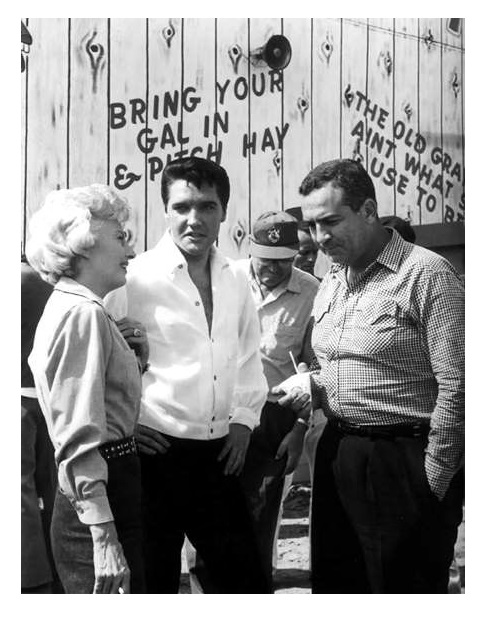
Stanwyck, Presley, Rich. 

Roustabout would be Rich's second feature film. “I didn’t know much about the musical theater,” Rich later confessed to Gurlanick. “I knew nothing about Elvis. I said, Why me? I had visions of doing rather grandiose pictures but I was going to do the very best I could and try to catch up as quickly as possible.” But despite his best efforts, things got off to a very rocky start.

Unlike Norman Taurog -- G.I. Blues, Blue Hawaii, Girls! Girls! Girls!, Rich had little patience for Presley’s rowdy entourage, their constant distractions and practical joking, which was eating up precious shooting time; and there were rumblings about getting them all banned from the set. “I’m not one for fraternizing too much with the group that are around the players,” said Rich. “But they were around quite a bit and you couldn’t ignore them.” Here, Presley personally intervened, saying, “When these damn movies cease to be fun, I’ll stop doing them. And if my guys go, (expletive deleted) it, so do I.” Things got even more testy on the third day of shooting when Presley insisted he do his own stunts for the fight scene at the roadhouse.

Feeling he was on thin ice already, Rich, against his better judgement, caved and let Presley have his way when he promised to take full responsibility if anything happened. Well, something did happen as the stunt went awry and the actor got clipped in the head just above his right eye to the tune of five stitches. Seeing his career going down the toilet for allowing this to happen, fearing the production would have to be shut down, Rich quickly hit upon the notion to incorporate the wound into the story, making it a result of being run off the road. His apologetic star was very grateful for the save, and after slapping on a bandage the production ran smoothly from there.

For authenticity, the production hired Craft’s 20 Big Shows, a large west-coast based carnival operation that wintered in North Hollywood. For the outdoor scenes, the show was erected in the Potrero Valley, near Thousand Oaks, California. For the interior shots, it was all uprooted and moved into three connecting sound stages on the Paramount lot. 

And to Rich’s credit, he exploited this carnival setting perfectly and Roustabout is one of the better looking Presley pictures of this period. Credit should also go to his cinematographer, Lucien Ballard, who shot most of Sam Peckinpah’s films -- Ride the High Country (1961), The Wild Bunch (1969), and The Getaway (1972).

Together, Rich and Ballard eschewed the normal traveling-matte abuse that plagued most of Presley’s pictures and kept it as all-natural as possible. From the opening song, Presley is actually on the road and on the move, singing in the breeze. There were also a couple of long, uninterrupted tracking shots along the midway that weren't easy and came off without a hitch. 

And I loved the point-of-view camera work when Rogers serenades his captive audience of one on the spinning ferris wheel, which helps engage the audience over the script’s massive short-comings. And speaking of shortcomings…

As for the music, well, I think the Roustabout soundtrack might be the worst collection of songs ever assembled for a Presley picture. And that is really saying something. Obviously, to keep costs down even more, Parker and Wallis weren’t exactly hiring top-notch songwriters for these pictures. Though it should be noted the best song of the bunch -- “Big Love, Big Heartache” -- was penned by Ed Wood’s ex-girlfriend, Dolores Fuller, who was his co-star in Glen or Glenda (1953). 

But the quality didn’t seem to matter because these soundtrack albums still sold and, by some miracle, Roustabout hit the top of Billboard’s Album Chart, knocking The Beatles off the top of the heap -- for one solitary week. It would be Presley’s last No. 1 album until the release of Aloha from Hawaii in 1973.

Roustabout was released to theaters in November of 1964 to not-so-stellar reviews but it still grossed nearly $3.3 million in ticket sales, satisfying both Wallis and Parker. But by contrast, The Beatles’ A Hard Day’s Night (1964) came out three months prior and was an absolute smash both critically -- it was “the Citizen Kane (1941) of jukebox movies” according to the The Village Voice, and financially, as it raked in a staggering $11-million dollars at the box office. And on top of that, the soundtrack sold over four million copies. Roustabout, meanwhile, tapped-out at 500,000. Both Parker and Wallis were well aware of this development but did little to nothing to meet or match this challenge posed by these British Invaders. In fact, they were kinda busy putting out a massive fire in their own camp that threatened to derail their cash-train permanently.

It was on the last day of principal photography for Roustabout when a certain story broke in the Las Vegas Desert News and Telegram, whose headline read “Elvis Helped in Success of Burton-O’Toole Movie.” The movie was Becket (1964) and, according to the article written by Vernon Scott for the UPI, which meant it appeared in papers all over the country, the more prestigious film wouldn’t have happened if not for “Sir Swivel Hips.” 

See, Wallis was interviewed for this article, who admitted that without the revenue generated by Presley, there might not have been enough “wherewithal” to film Becket, saying, “In order to do the artistic pictures, it is necessary to make the commercially successful Presley pictures. But that doesn’t mean a Presley picture can’t have quality, too.” The article then concludes by saying Roustabout, currently filming at the time of publication, might not be the greatest, but then Peter O’Toole and Richard Burton couldn’t sing like Elvis either.

 From the April 24, 1964, edition of The Desert Sun, Palm Springs, CA.

Well, the shit kinda hit the fan after that. Feeling he was being played for a rube, and a direct hit on his insecurities, Presley didn’t appreciate being thrown under the bus like that by his producer. (For the record, Wallis did the same disservice to his Dean Martin and Jerry Lewis pictures, too, in the same interview.) Or how Wallis was earning himself Academy Awards on the back of his box-office earnings, little of which actually trickled down to his own picture’s meager budget coffers. Thus and so, stuck between Wallis and Parker, if there were any doubts left about his acting career being taken seriously, they were gone now. And while he was contractually obligated to perform for Parker in future pictures, you can tell Presley had kind of checked-out from this moment on, acting wise -- especially on the Wallis pictures.

I guess one could take some grim satisfaction on how Parker’s machinations, hubris, and staunch refusal to try anything different, or how his cost-cutting demands for cheap turnarounds and backdoor profiteering, which kept resulting in lower and lower box-office returns, which then begat cheaper and even more dire films, meaning even less profits, led to his own undoing -- it's just too bad he had to take Presley with him. And as his star lost his luster on the big screen, his outlandish salary demands were soon met with indifference.

But Parker did finally get that million dollar payday. For one picture, Tickle Me (1965). But it was all downhill from there. Wallis would officially bow out of Parker’s circus after Easy Come, Easy Go (1967), and Presley’s Hollywood experiment officially came to and end with Change of Habit (1969).

And so, basically, when filming began on Roustabout, Presley’s film career was precariously teetering over a precipice. And by the time it had wrapped, it was officially over, nudged into a near fatal plunge by both Wallis and Parker. Sure, there was still plenty of entertainment to be squeezed out of what came after, when taken as the goofs they were intended to be, but things would never be the same in the Presley camp. His film career, for all intents and purposes, was dead, but nobody bothered to tell the Colonel, who failed to see that his much vaunted carnie sawdust had turned to ash.

Originally posted on April 26, 2008, at Micro-Brewed Reviews.

Roustabout (1964) Hal Wallis Productions :: Paramount Pictures / EP: Joseph H. Hazen / P: Hal Wallis / AP: Paul Nathan / D: John Rich / W: Anthony Lawrence, Allan Weiss / C: Lucien Ballard / E: Warren Low / M: Joseph J. Lilley / S: Elvis Presley, Barbara Stanwyck, Joan Freeman, Leif Erickson, Pat Butrum, Joan Staley, Sue Ane Langdon, Norm Grabowski, Racquel Welch, Billy Barty, Richard Kiel