

As a buxom blonde typist sporting some long and glossy-red press-on nails bangs out the opening credits on a Commodore-64, whose input promises not only four former Playboy Playmates but also Miss Overdrive of 1984, I’m already resisting the urge to activate the elapsed timer to see how much longer it will be before we get to our first nude scene (-- more on this and this film’s legendary reputation on its naked boobage per-square reel quotient in a sec).
Our movie proper then begins in the parking lot of a shooting range, where a DeLorean screeches to a halt before belching out of its gull-wing doors one Cody Abilene -- private detective, good old boy, and, he’d have you believe, God’s gift to women.


Notice how I didn’t say marksmen, as Abilene (Hinton) heads inside and produces a huge, overcompensating .44 magnum revolver from his cowhide briefcase. (Tasteful, without being gaudy.) And after an instructor sets-up a paper target and puts it in motion, our boy takes aim, fires, and proceeds to hit everything EXCEPT what he was actually aiming at. But Abilene just shrugs off this shitty display of marksmanship, puts the gun away, and leaves. (And we all agree that the establishment of our protagonist being a horrible shot will result in some high hilarity later on, right? Right.)
Cut to a racetrack, where Abilene intently watches a souped-up I-Roc Camaro roaring around the circuit. And when it finally pulls in for a pit-stop, out pops the driver, who goes by the handle of -- wait for it -- June Khnockers (Wiesmeier); and as our hero boggles at her voluptuous, namesake curves, the feeling appears to be mutual as Ms. Khnockers goes all doe-eyed by the mere sight of Abilene -- just like all the other women that’ve entered his orbit thus far, we observe, meaning this dipstick most likely has more than a few notches etched into his errant “six shooter” -- if you know what I mean and, as a wise man once said, “I think you do.”


Following her into the locker room, the woman slithers out of her racing outfit, revealing not a thing underneath it. (And a quick glance at the running time shows 2-minutes and 36-seconds. Mark it.) Here, Abilene announces that June’s breasts are just like her driving: pure dynamite. And with what passes for foreplay in this movie now out of the way, these two *ahem* “go for another spin ‘round the track.” Hopefully his aim is better here.
With that, Abilene heads home; home being a marina, where his boat, the Malibu Express, is currently docked. But not for long, as his neighbors, led by a Doug Wilton (Darnell), once more demand Abilene remove his eyesore of a boat from the harbor and to never, ever come back. But since his family apparently established this marina, making the Malibu Express a permanent resident, the detective suggests they all go take up their beef with his daddy.


Well, turns out they tried that but Old Man Abilene apparently entered a regatta with an all-girl crew several weeks ago, hasn’t been heard from since, and is now feared “lost at sea.” But his son isn’t all that worried and guarantees, with that crew, the Old Man isn’t lost at all and knows exactly where he is.
Now, once he finally gets aboard the Express, Abilene finds two more girls, Faye and May (MacArthur, Edwards), waiting in playful ambush, who just parked their own boat in the adjoining slip and wanted to borrow his shower. I mean, Why not? It’s been at least three minutes since we've had any nakedness, right? And as the soundtrack warbles "I’m in Love with the Girl on the Playboy Centerfold," we get an extended shower scene with these two (-- making that three pairs of boobies in less than five minutes.)


We then shift-scenes over to Wilton, who, ensconced in a super-secret spy room filled with lots of monitors and blinking lights, is not what he first appeared to be. Enter, stage-left, Countess Luciana (Danning), his top operative, who’s a little upset that her vacation was interrupted for this latest covert assignment. Seems those pesky Russians are quickly closing the computer gap because someone has been selling them stolen hi-tech secrets; and this trail of espionage leads back to the mansion home of Lady Lillian Chamberlain, a familiar acquaintance of the Countess. And since those two know each other, Special Agent Wilton felt that another, independent party should be brought in to help investigate Lillian and her unruly brood.
And you won’t even need three guesses to figure out who he has in mind to fit the bill. But Abilene must get Luciana’s seal of approval first by passing her spy-litmus test: One, Is he cute? And two, Is he any good in the sack? And the answer to those questions plus a whole lot more is, quite obviously, Our Democracy is doomed…


With the advent of the Home Video Market and the proliferation of hardcore pornography that you could watch privately at home with your very own video cassette player, it kinda cut out the middle-man and created a bit of a vacuum of redundancy in the exploitation movie market as the old grind-houses and drive-ins were shuttered-up due to a lack of a drawing product.
Thus, a new genre was born to fill that nebulous gap: the T&A Flick -- Tits and Action if you’re feeling vulgar, or Tits and Ass if you were feeling REALLY vulgar, whose origin can be traced back to the Nudist Pictures and Nudie Cuties of the late 1950s and ‘60s and the Roughies that followed, which nearly went extinct until they evolved and adapted throughout the 1970s as genre films started to be punched-up with ah-lot of sex and bared breasts and bottoms, resulting in a boost at the box-office.

Exploitation King Roger Corman had turned the burgeoning T&A Flick into a cottage industry after he formed New World Pictures back in 1970, starting with The Student Nurses (1970). And he adapted with the times in the ‘80s, too, providing more fodder and eye candy for the video store aisles for those too embarrassed to wander into the segregated area, behind the saloon doors, where the brown clamshells awaited, right by the Kid’s Castle in my hometown Applause Video, to get their pervert on. Others would follow suit, including one Andy Sidaris.
Now. It all kinda depends on your personal perspective or point of view on such things, but the going consensus on Sidaris’ films is that they either had too much plot in your porn or too much porn in your plot. Unfortunately -- or fortunately, again, depending on how you read it, Sidaris could never really find the right balance and usually wound up with too much bad plot -- or no plot at all, and then tried to overcompensate for this with lots and lots of gratuitous nudity, car chases, gun fights, and explosions, making him the undisputed King of T&E Flicks -- that'd be Tits and Explosions, a slight twist on the common vernacular, for those playing at home.

“First of all you’ve got, physically, things bounce, and I go for that. And I think the audience likes that,” Sidaris told Joe Bob Briggs (John Bloom) during an appearance on Joe Bob’s Drive-In Theater (January 1, 1995). “When in doubt, you go to the naked body or you go to the hot tub, which includes naked bodies.”
Born in Chicago in 1931, after his father died Sidaris spent his formative years playing football for C.E. Byrd High School in Shreveport, Louisiana, quarterbacking the only game the school won in 1947. He then attended Southern Methodist University in Dallas, Texas, to pursue a career in journalism. Needing money to pay for his studies, he got a job at WFAA-TV in Dallas around 1950, where he quickly learned the nuts and bolts of broadcast television and quickly settled into a new vocation. And in less than four months the ambitious 19-year-old was directing 14 live shows a day.


In 1952 he produced and directed his very first live football telecast, and Sidaris would go on to revolutionize how sporting events would be covered. In a profile by Jerry Byrd for his newspaper column, Birds Eye View of Sports (July 20, 1967), Sidaris said, “Sometimes they (meaning other networks) use one wide lens and show you all of [what’s] happening at the same time. But that’s the easy way out.” The harder, Sidaris way was using quick cuts and multiple cameras to cover the ongoing action and aftermath, and he pioneered the integral use of split screens, slow-motion and instant replay.
By 1960, Sidaris had gone national when he was appointed Senior Sports Director for the ABC Network, where his credits for this period included football and basketball (both professional and collegiate), baseball and golf. He also helped establish the thrill of victory and the agony of defeat with ABC’s Wide World of Sports in 1961 and ushered in the era of Monday Night Football in 1970, accumulating Emmys as he went -- 14 in total, including one for his work covering the 1968 Summer Olympics in Mexico City. “The live aspect of this work, and the honesty of sports, gives me a bigger thrill than directing other types of shows.”


Yeah, I always giggle a bit when I see his name listed in the credits whenever I watch a rebroadcast of the Game of the Century between Nebraska and Oklahoma from 1971, knowing full well what was to come later. And I think college football was always Sidaris’ true love -- but not necessarily for what was happening on the field but more for what was decorating the sidelines.
“They call him the father of the Honey Shot,” Mary Flannery said of Sidaris in a scathing article penned for the Philadelphia Daily News (May 11, 1982), “Which is an industry term for the crowd shots of pretty girls. It is a dubious title he wears quite proudly.” But not all girls were made equal.

As far back as 1969, in another profile piece for The Miami News (December 16, 1969), Al Levine referred to Sidaris as the “Magic Eyeball,” who specialized in what Sidaris called “sun-kissed chickadees and other art forms.” And for the duration of the article, which ranks colleges not by their football prowess but by how hot their cheerleader squads were, Sidaris comes off as, well, “slightly” misanthropic as he makes it quite clear his obsession with all things mammary.
“The South dominates the field, of course. But the most talent has been concentrated in Los Angeles,” Sidaris told Levine. “We saw so much talent in the grandstand [at the USC-UCLA game] that the telecast should have gotten an ‘X’ rating … UCLA’s cheerleaders have been No.1 in the past, but they’re rebuilding. Weather is a big problem for the Eastern schools. It is hard to rate high when the chicks are wearing Army ponchos and sneezing a lot. Our telecasts of the Ivy League were so dull, we had to actually show some of the football action.”

The girls of the midwest schools didn’t fare much better in Sidaris’ biased eye. “It’s tragic, but Big 10 girls dress like something out of a 1939 Joan Crawford movie. To them ‘chic’ means not wearing overalls.” But, “I do have to give an asterisk -- the Purple Heart Award -- to Purdue’s Golden Girl, who performed her half-time act in a blizzard. Believe me, she melted the snow for six rows up.”
Professional teams weren’t immune either. For after suggesting the city of Buffalo got its name because all the women there were all bovine in nature, this balding, portly man -- basically a pumpkin-headed pickle-barrel with legs, was allegedly run out of town never to return.

Outside of sporting events and perky sideline cleavage, Sidaris' first directorial efforts was, strangely enough, a children’s program, The Magic Land of Allakazam, which ran from 1960-1964 out of Los Angeles. His first feature was a documentary, The Racing Scene (1969), which focused on actor James Garner’s dalliance with Grand Prix auto racing, showing him assembling a team, a car, and driving the circuit around the world for one calendar year. And he would also serve as the “football choreographer” for Robert Altman’s M*A*S*H (1970).
Now, when he was a kid, Sidaris had an uncle who served as a father figure, who owned several movie theaters in the Kansas City metro area, where he would spend summers riding around with him as he collected receipts, hanging around the projection booths, watching films spool out. Thus and so, since that early age he had been fascinated with motion pictures, too. And in 1972, he would team up with Roger Corman for his first feature film, Stacey! (1973), whose plot will ring a little familiar as a spunky lady detective / race car driver roots out a killer inside a mansion full of backstabbing kooks.

The film was co-conspired with Leon Mirell, who had produced the satirical Watermelon Man (1970) and The Killing Kind (1973) -- a criminally overlooked psychological thriller about a nascent serial killer and his relationship with an enabling mother. Sidaris and Mirell are credited with the story for Stacey!, while the actual script was hammered out by William Edgar, who was the credited screenwriter for The Racing Scene, and who also wrote Body Fever (1969), a sleaze noir for Ray Dennis Steckler -- The Incredibly Strange Creatures Who Stopped Living and Became Mixed-Up Zombies (1964), Rat Pfink a Boo Boo (1966). Also helping out on the financing was Michael Trikilis, who would go on to produce Playboy’s Roller Disco & Pajama Party (1979) and later provide the vast majority of content during the natal days of The Playboy Channel.
Corman, meanwhile, was an uncredited co-producer who also provided distribution through New World. Sidaris would later comment that Corman was a “pain in the ass” to be in business with but was willing to put up with it for the opportunity to direct his first feature (IMDB Trivia). And the end results, well, aren’t very good. But you can definitely see the inklings of what would become the hallmarks of Sidaris’ later films that hadn’t quite found the temperature yet: It starred Playboy Playmate Anne Randall (May, 1967), contains a lot of gratuitous nudity, a couple of sex scenes, awkward gun violence, an awkward chase scene, an awkward, interminable climax, and whose awkward denouement does the best it can to awkwardly tie-up numerous loose plot threads.


So, yeah, at this point, Sidaris was still concerned with things like 'plot' and 'continuity', something he wasn't very good at and would later remedy further down the road by just not worrying so much about these piddling details anymore. And after directing episodes of Kojak (1973-1978) and Gemini Man (1976), and cameoing as a TV-director in the jumbled action thriller Two-Minute Warning (1978), a film that was completely redone for its Network TV debut, Sidaris was ready to try another feature with Seven (1979) -- this time for Sam Arkoff and American International Pictures.
Originally intended as a vehicle for Burt Reynolds, Sidaris had to go with exploitation character actor extraordinaire William Smith as a Plan B, who played special agent Drew Savano. Savano is charged with assembling a team of specialists of his choosing to foil a cartel of crime bosses hellbent on taking over Hawaii through a series of political assassinations. Here, Savano’s Seven consists of a hot ex-Playmate, a hot helicopter pilot, a kooky professor, a comedian reeking of borscht, the jive-token black guy, a karate expert, and a slick hick.

Again, Sidaris cooked up the story, which was then punched-up by veteran TV-writer William Driskill -- Highway Patrol (1955-1959), The Six-Million Dollar Man (1974-1978). It was co-financed by Arkoff and Melvin Simon, another independent producer, who was also responsible for William Girdler’s The Manitou (1978), Love at First Bite (1979), The Stunt Man (1980) and Bob Clark’s Porky’s (1981), Porky’s II (1983) and Porky’s Revenge (1985).
“Death is Their Way of Life” screamed AIP’s promotional campaign for Seven. And as Marty McKee summed it up so eloquently in his review for Johnny LaRue’s Crane Shot (November 29, 2015), “Whereas his first movie, Stacey!, was a straightforward action movie punctuated by occasional nude scenes, Seven is an elaborate adventure boasting a reasonably professional cast, a sprawling story-line, and lush Hawaiian locations.” But, “Don’t worry [it’s] still definitely a Sidaris movie, and that means plenty of gorgeous top-heavy women on display, as well as corny jokes, an unnecessarily convoluted plot, and elaborate methods of murder.”

Thus, Seven added even more elements -- Hawaiian backdrops, nonsensical gadgets and ludicrous deaths -- that would eventually solidify into boilerplate for Sidaris. But it would be another six years before he would try again. Only this time, he was ready to do it on his own independently -- only he still wouldn’t be doing it alone. In his autobiography, Bullets, Bombs and Babes: the Films of Andy Sidaris, the author and subject matter said the smartest thing he ever did was to marry Arlene Terry Smilowitz. “She is my producer and the love of my life.”
A native New Yorker, and a died-in-the-wool Brooklynite, according to an article by Charles Witbeck (The Tampa Tribune, June 26, 1977), Arlene Smilowitz initially kind of lucked her way into show business. Back around 1960, after three years of college, and soured on the prospects of a career limited by her gender to either teaching or nursing, she was lured out of school at the age of 19 by an advertisement for a career that promised exotic travel, which, well, turned out to be nothing more than a scam for selling travel magazines door to door. But while waiting for an interview for said job, a man from a nearby office took pity on her, clued her in on the snow-job, and threw her a lifeline, saying he had a friend she could work for at the William Morris Agency.

That ‘friend’ turned out to be Bernie Brillstein, an agent, who would later represent the likes of John Belushi, Dan Aykroyd and Jim Henson, and produce films like The Blues Brothers (1980) and Ghostbusters (1983). Arlene was hooked, mesmerized by the star wattage that would haunt the offices and the perks like free tickets. But after two years, when her mother refused to let her move to Manhattan to be closer to her job, Arlene decided to move even further west than that and all the way to California, where luck was with her again.
Apparently, as the legend goes, writer and producer Leonard Stern -- The Honeymooners (1955-1956), Get Smart (1965-1968), needed to expand his secretarial pool but had stubbornly rejected all applicants until his current secretary made him promise to hire the next person that walked through the door, who just happened to be Arlene Smilowitz.

From there, Arlene worked her way up the chain, from secretary, to gofer, to continuity, to script supervisor, to production assistant on I’m Dickens, He’s Fenster (1962-1963) and The Les Crane Show (1964-1965) -- later retitled ABC’s Nightlife, which was the network’s first attempt at counter-programming against NBC’s The Tonight Show. And like The Tonight Show would do later in 1972, Nightlife left New York City and relocated to California in the fall of 1965. Here, Arlene attended a housewarming party thrown by Crane and his wife, Tina Louise, which is where she first met Andy Sidaris, introduced by mutual friend and fellow TV-director, Mac Hrmiom.
Sidaris was married at the time to Anne Sidaris-Reeves, and had two children, but was well on the road to a divorce that was eventually settled in February, 1966. It’s uncertain when Andy and Arlene officially started dating. But according to an interview with John Solari for The Method Actor Speaks (June 5, 2012), Arlene said Andy fell for her hard and wanted to put her on a "five year hold" the night they met but then married her one year later in late 1966 or early 1967. The two would have a daughter, Alexa, in May, 1970. (Now, for the record, this whole Andy and Arlene Sidaris timeline was put together from several sources; some precise, some vague, and some of them contradictory; so while this retrospective calls for some conjecture to fill in the gaps, it’s as earnestly accurate as we’re able to get at the time of this writing.)

Professionally, after Nightlife was canceled not long after that move out west, replaced with the similarly ill-fated The Joey Bishop Show (1967-1969), the now married Arlene Sidaris stayed in the production trenches as an assistant to the producer on things ranging from The Glen Campbell Goodtime Hour variety show (1969-1972) to the Made for TV Movie, The Missiles of October (1974), a docudrama on the Cuban Missile Crisis.
It was during this period that Arlene struck up a friendship with Joyce Brotman, who followed the same career path as her new best friend; but now both had kinda stalled-out as associate producers, which meant long hours, little credit, little pay, and not being qualified for benefits like health insurance.

According to that same interview with Witbeck, Brotman had been a schoolteacher in Baltimore before landing a secretarial job at MGM, earning her way up to production assistant on shows and specials featuring David Frost and Alan King, “working long hours, especially during program editing, assisting the cutter, the director and the producer.” Eventually landing at Universal, Brotman ran into a former colleague, who noted, “‘I know you -- you’re the girl in hot pants who always brought back egg sandwiches.’”
“Traditionally, [being an associate producer had] been the end of the line for women,” Sidaris told Cecil Smith (Los Angeles Times, March 6, 1977). “We knew that from where we were, there were only two ways to go -- to produce or direct.” Added Brotman, “And realistically, being women, we knew nobody was going to hire us to direct, so we’d better find some project of our own to produce.”

Looking to their past, both women settled on a possible TV-adaptation of the Nancy Drew mysteries by Carolyn Keene, which led them to the Edward Stratemeyer estate, who, under a myriad pen names and ghost writers, had created Nancy Drew, Tom Swift, the Bobbsey Twins and dozens of other juvenile adventurers. The Nancy Drew series had already been adapted to film back in the 1930s, featuring Bonita Granville as the amateur sleuth in Nancy Drew, Detective (1938), Nancy Drew, Reporter (1939), Nancy Drew, Troubleshooter (1939) and Nancy Drew and the Hidden Staircase (1939), but not much else over the ensuing forty years.
Alas, someone else had the same idea and the rights to the Drew books had already been optioned. But! There was a consolation prize as the two women scrounged up the $2500 required for an option on another Stratemeyer creation, The Hardy Boys, who hadn’t been on TV since they’d showed up on The Mickey Mouse Club back in the 1950s, looking for the gold doubloons and pieces of eight of old man Applegate.

And so, in September of 1976, Sidaris and Brotman made their series pitch on the boy detectives to Universal executive Tom Tannenbaum, who liked their contemporary approach on the material and ordered a pilot. And during this pre-production phase, Tannenbaum also broke the news to his new producers that the rights to Nancy Drew had since become available and were optioned by Universal, paving the way for what was to become the rotating anthology series, The Hardy Boys / Nancy Drew Mysteries (1977-1979).
From there, the duties were split, with Brotman focusing on the Hardy Boys and Sidaris on Nancy Drew. Both were shepherded by legendary writer and producer Glen Larson -- The Six Million Dollar Man, Quincy M.E. (1976-1983), Battlestar Galactica (1978-1979), Magnum, P.I. (1980-1988), who would serve as the show’s executive producer. “He’s incredible,” said Brotman. “He wrote both our pilot scripts, directed the first Hardy Boys, wrote the second Nancy Drew in two days, and even composed the music for the series.” And Arlene would later recruit her husband to direct the football themed episode of Nancy Drew, Mystery of the Solid Gold Kicker (Season One, Episode 14).

When the duel pilots were completed -- filmed around the clock, the series was picked up in November and then fast-tracked into production by the network as a mid-season replacement for Cos (1976-1977), Bill Cosby’s floundering variety show, with a premiere date set for late January, 1977, in a killer Sunday night time-slot against CBS’ 60 Minutes (1968-) and NBC’s The Wonderful World of Disney (1954-).
And so, in a three month whirlwind, the series went from pitch, to pilot, to on the air. A recipe for disaster for sure. But with an appealing young cast of Parker Stevenson, Sean Cassidy and Pamela Sue Martin, The Hardy Boys / Nancy Drew Mysteries proved to be a surprise hit and managed to beat Disney in the ratings and knocked 60 Minutes out of the Nielsen Top Ten for a spell, earning a second season.

But the ratings also showed The Hardy Boys episodes, perhaps buoyed by Cassidy’s coincidental breakout as a recording artist, were the bigger draw. And so, accordingly, the second season leaned heavily into The Hardy Boys with 13 of 22 episodes dedicated to them with only three Nancy Drew solo adventures with the rest being crossover episodes, including the totally bonkers season premiere which found all three in Transylvania for a rock festival at Dracula’s castle for … reasons. Of course I’m not making that up!
With the writing on the wall, Pamela Sue Martin bailed on the series but landed on her feet with roles in films like The Lady in Red (1979) and the prime-time soap Dynasty (1981-1988). Thus, with her departure, the Nancy Drew segments were dumped altogether for the third season, which saw Joe and Frank Hardy joining the Justice Department. But after only airing ten episodes of The Hardy Boys, the series was abruptly canceled in January of 1979. From there, Arlene moved on and teamed up with Beverly Camhe and Carol Sobieski, writing and producing the Made for TV Movie, Obsessed with a Married Woman (1985).

Meanwhile, in March of 1985, ABC went through a massive regime change when Capital Cities took over, which announced all kinds of cutbacks in all divisions, including their sports coverage, leading to Andy Sidaris’ abrupt resignation and departure after some 25-years of service. Arlene also left ABC around the same time, signing a development deal with MGM. And so, needing something to do and another source of income, Sidaris decided it was time to make another movie. And the movie in question was Malibu Express (1985). And this time, as I said, Sidaris would try to do this one on his own, forming his own production and distribution company, Malibu Bay Films.
Now, technically, this would be Sidaris’ second attempt to make this particular movie. Originally, he had planned to shoot Malibu Express on his own before Seven but the financing fell through. For this round, Sidaris struck a co-financing deal with Hugh Hefner. Both would put up $250,000, with Sidaris handling the production while Hefner provided the eye candy.

As Arlene told Noel Gross in an interview for DVD Talk (October 25, 2002), “Playboy has a casting department and they'll send the girls over for an interview. The jobs that they send them on are very varied -- everything from supermarket openings to major motion pictures.”
For the script, Sidaris basically cannibalized the plot from his earlier film, Stacey!, with Cody Abilene replacing Stacey Hanson, which was then doctored and punched-up by Arlene. As Sidaris told Briggs about his writing process, “I usually think about it for two weeks and then pound it out in four days. Arlene then reads them, embellishes them, adding things like ‘plot’ and ‘motivation’.”


And like with Seven, being a self-proclaimed James Bond fan, a secret agent / espionage angle was added to this gender-swapped unofficial remake as this time Abilene and agent Luciana must root out a nest of spies ensconced in the Chamberlain mansion -- once Abilene passes Luciana’s spy test, that is, which he does after a Moog-synthesizer powered evening of dinner and dancing inevitably leads back to Luciana's bedroom, where she wears Abilene out, who barely passes her litmus test before passing out exhausted.
The following morning, Abilene has the first of three bizarre encounters with the Buffington clan. Seems the Buffingtons and the Abilenes have had a running feud since Abilene’s daddy beat their daddy in a stock car race some thirty years ago, which means that at any given time, the Buffingtons -- P.L. (Dickson), Doreen (“Busty” O'Shea), and their idiot inbred son, Bobo (Rudy) -- roar up out of nowhere and challenge Abilene to a race.


Now, despite the genetic hand dealt him, Bobo appears to be a mechanical genius because his car blows the DeLorean’s doors off. But as the hillbillies celebrate their victory, the nitrous-oxide he used to win detonates their car, allowing Abilene to slip away to stately Chamberlain Manor, where Luciana has arranged for him to stay a while.
Greeted by Shane the butler / chauffeur (Clark -- whom sharp eyes with long memories will recognize as ‘Nick the Dick’ from Bachelor Party (1984), he introduces Abilene to the wheelchair bound Lillian (Dantre), who seems to be keenly aware of her guest’s mission to find the spy amongst her philandering family of miscreants, currently gathered around the dining room table:


First up we have her youngest daughter Liza (Michaels), a hottie that’s involved with the head of a fledgling computer company, who is sleeping with Shane. Next, is her daughter-in-law Anita (Morgan), a bitter alcoholic, who is also sleeping with Shane, And lastly is her son, Stuart (Andrews), Anita’s husband and a secret transvestite, who sneaks out at night in drag and hangs around gay niteclubs, and who, sticking with the theme, is also sleeping with Shane.
Also of note, Shane is an ex-con who has incriminating videos and photos of all his romantic interludes with the entire Chamberlain clan as he completes his nightly bedroom crawl -- some of whom engage with him willingly while others do not; namely Liza, who is assaulted while trying to take a shower.

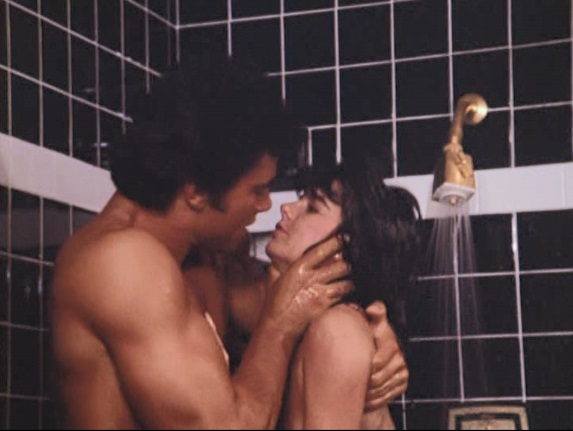

Come the dawn, Liza takes Abilene to Palm Springs to meet Jonathan Harper (Steinmetz), the seedy computer start-up guy she’s dating. Here, Abilene witnesses a dubious exchange of cash between Liza and Harper, which gets Harper’s goon squad on his tail.
And so, Matthew (Metrano) and the 'roided out Mark and Luke (Brose, Brown) escort Abilene off the premises and later run him off the road, which is odd because he was already leaving like his boss wanted until they stopped him, and then proceed to beat the crap out of our hero. And to punctuate the message from their boss (-- which is what exactly?), Matthew whips out a machine gun and obliterates Abilene’s car.


Thus, after limping down the desert highway for a spell, Abilene finds his way to a used car lot, whose female owner was already stripping before he’s even within ear shot (-- making me suspect that Abilene is a mutant with the power of pheromone secretions that trigger the female libido, which is the only possible rational explanation for the women’s behavior in this movie). And after an exchange of *ahem* “services rendered” he’s given a loaner car and returns to the Chamberlain estate, where he overhears a heated conversation between Shane and his bookie.
Seems Shane is in the hole for over $30,000 and needs money to pay off that debt fast. He tries Anita first, showing her the secret footage of their intercourse; but this blackmail attempt backfires and results with an angry wish that he winds up dead. He tries Stuart next, showing him the same photos while driving him to The Screaming Cockatoo, a frequent hangout of the drag queen. But Stuart could care less about the photos of Shane screwing his wife, and even less than that when confronted with photos of the two men sleeping together. Man, Shane isn’t very good at this.


Later, Lillian throws a party and everyone’s invited. Luciana is there with Abilene; Harper is there with Liza, trying to talk Lillian into investing in his company; and Shane runs into his bookie, who just happens to be running the catering service used at the party. And with his time running out -- he needs the money by tomorrow or he’s a dead man, Shane decides to turn up the heat on the Chamberlains.
Returning to his quarters, Shane starts gathering up all of his blackmail material for another try -- this time I think the plan was to show it all to Lillian, unaware that someone else had snuck into the room behind him until said person repeatedly stabs him.


Here, one can't help but notice that the masked attacker has some feminine curves, but I remind everyone this doesn’t rule out Stuart. And as his assailant gathers up all the photos and videotapes, Shane manages to take one last picture before he's finished off with a well placed gunshot.
The next morning, while Luciana sunbathes by the pool and compliments the swimming Abilene on how great he was in the sack last night, these two crack investigators finally notice Shane’s body some fifteen feet away, who apparently managed to crawl out of his bungalow before expiring. And since Luciana is supposed to catch a plane to Europe for … reasons, Abilene, knowing she couldn’t have done this since they spent the whole night screwing, orders her to clear out quick before calling in the cops.


Meanwhile, hearing noises inside the victim's bungalow, Abilene finds Anita rummaging through all the drawers, obviously looking for those blackmail photos, but the woman won't reveal what she's been searching for. After kicking her out, Abilene secures the crime scene by, one, smearing the blood spatter; and two, leaving his fingerprints all over; and three, tampering with the evidence, including Shane’s camera, confiscating the last roll of film found inside it.
Next, he rounds up the entire Chamberlain clan and orders them to clam up and let him deal with the cops. And this he does, by first calling his personal phone service -- who apparently moonlights as a phone sex operator because, sure, why not, who calls in the police; specifically homicide detectives Arledge (Alderman) and Macfee (Sutton). When they arrive, Aldridge presents Lillian with an envelope sent to him that very morning. Inside are all of Shane’s illicit photos. And so, as Lady Lillian vents her disgust at her progeny, and Shane’s body is hauled off to the morgue, the crabby Lt. Arledge (-- who I assume was named after Sidaris’ old boss at ABC, Roone Arledge --) takes Stuart in for questioning and warns everyone else not to leave town.


But, turns out Detective Beverly Macfee is an old acquaintance of Abilene’s -- in a wink wink, nudge nudge, they’ve totally screwed before sense. And so, he accompanies her to the boathouse, which served as Shane’s love pad, to look for more clues and compare notes. And while Macfee believes Stuart is their prime suspect, as far as Abilene’s concerned everyone had both motive and opportunity to kill the lecherous Shane.
Meantime, the Chamberlain’s other servant -- wait for it -- maid Marion (Hilton, whom those with sharp eyes with long memories will remember as the Governor's secretary in Blazing Saddles (1974), is spying on the Chamberlains for Harper. Told Abilene and Macfee are in the boathouse, Harper sends two more goons, Peter and Thomas (Knecht, Trikilis), to go kill them and retrieve the film Abilene took. Wait. How do they know he has the film? No. I’m asking you! And, wait a second. Peter and Thomas? Along with Matthew, Mark and Luke? I assume the rest of the disciples were busy somewhere else?


Anyhoo, after a cursory search of the boathouse, Abilene and Macfee renew their relationship and do the dippity-boppity-do. In the aftermath, Abilene finds the remote that controls the hidden cameras aimed at the bed and starts piecing it together on what Shane was probably up to. But they barely have time to shower up before spotting Harper's armed goons headed their way, who kick in the door but find the bedroom empty. They hear the shower running, then move into the bathroom, pull the curtain back, and come face to face with Abilene’s .44 Magnum.
However, even at that close range, Abilene, true to form, blasts away and hits everything but the bad guys. Luckily, Macfee proves a far better shot and blows them both away. Here, the two realize the only person who knew where they were headed was Lillian.


That night, after another close encounter with the Buffingtons, Abilene returns to his boat and finds his two new neighbors inside, in his bed, wanting to play a game of slap 'n' tickle. But there’s no time for that because he’s been followed there by Matthew and the Steroid Twins. Here, Abilene tells the girls to hit the floor while he once more draws his gun -- like that’ll do any good. But, to his credit, he does manage to blow Matthew’s ear off (-- I’ll assume he was aiming for his foot), who retreats.
And while he gives chase, Mark searches the boat and orders the girls to hand over the film, who, of course, have no idea what he’s talking about. A quick search turns up nothing, and so he leaves empty handed. When Abilene returns after the others get away -- well, except for one ear, I guess, his guests fill him in on what the bad guys were really after.


Come the dawn, Abilene relates this newly discovered connection between Shane’s murder and Harper’s computer firm to Macfee over the phone. He also confesses to removing evidence from the crime scene and says to meet him at the racetrack, where a photographer friend has a darkroom because of course he does.
Once there, they watch Ms. Khnockers drive a few laps while the film is processed, which reveal more pictures of Shane having sex with the myriad Chamberlains -- except for the last photo, which reveals his killer. And once the photo is enlarged, Abilene and Macfee both recognize who the killer is (-- of course they don't let us see it yet, but to be fair, I’m pretty sure Sidaris, the man who wrote the script, hadn’t settled on who the killer was yet either).


Gathering up the evidence, as they reach the parking lot, a shot rings out and Macfee takes one in the shoulder. Moving to protect her, Abilene once more faces off with Harper’s goon squad. Drawing them away from his wounded partner, Abilene winds up on the track and borrows June’s I-Roc; but she jumps in with him before he peels out. To give chase, Matthew commandeers a helicopter.
Back in the car, things get even more complicated when June gets turned on by the speed and starts stripping, wanting to, um ... “wax Abilene’s stick shift.” And as our boy tries to convince her that someone’s trying to kill them, she doesn’t believe this until they start getting shot at. Meanwhile, Matthew orders the pilot to fly ahead so they can set-up an ambush.


Once they're dumped off, the head goon produces a grenade and pulls the pin just as the I-Roc comes into view. But Abilene is going too fast, and suitably distracted by June can’t avoid him; and so, he bounces Matthew off the bumper, who flies into the ditch, still clutching that grenade, which is dropped on impact and explodes in a cloud of flying body parts.
Alas, Matthew provided a big enough speed-bump to cause the speeding I-Roc to wreck into an off-road sign. But Abilene and June manage to bail out before the Steroid Twins chase them further into the desert, where they take refuge behind a large rock.


Here, Abilene reveals he only has one bullet left just as Mark comes into view. But June flashes her namesake knockers, distracting him long enough for Abilene to fire and, glory be, actually hit him. Our hero then takes up Mark’s discarded gun and blasts Luke. Again, I will assume he was aiming for the scrub behind him and hit Luke by accident.
After making their way back to the highway, June uses her "headlights" again to stop a Winnebago. After the driver (Sidaris, getting his Hitchcock on) happily gives them a lift to town, Abilene checks to see if Macfee’s all right. She is, and he informs the recovering detective that he's finally figured it all out and to bring the cavalry to Harper’s office, where, at this very moment, a wild topless party is going on (-- which pushes the running total of boob shots in this movie to its staggering zenith. Again, more on this in a sec).


But this all comes to a screeching halt when the police raid the warehouse, where they find Harper showing Liza the video of Shane and her sister-in-law doing the old bump ‘n’ grind. Here, Abilene tells Arledge to arrest Liza for the murder of Shane, producing the coveted photo that clearly shows the girl under the nylon stocking. Case closed. Hah! You wish. Nope. We still gotta survive the rock stupid denouement where Abilene gets to explain everything. Sort of. And badly.
Gathering all of the players onto his boat -- Wilton, Macfee, Arledge, June, and the entire Chamberlain clan, including Liza, seems something about the case just didn’t sit right with our hero after he noticed the incriminating photo showed Liza holding the gun in her right hand when everybody knew Liza was left-handed. (And, yes, we’re gonna have to take his word on that.) Thus, someone was trying to frame the girl for murder. And since she didn’t do it, and Anita couldn’t have done it, being way too drunk after the party, and Lillian, confined to her wheelchair, rules her out, which just leaves Stuart. But he couldn’t have done it either because the forensics show he was too tall for the lethal bullet trajectory. (Forget it, he’s rolling.)


That means, of course, the killer could only have been Luciana. And with Wilton’s blessing, Abilene reveals the Countess is really a secret-agent, who eliminated Shane because he was working for Harper, who in turn was selling computer secrets to the Russians. But didn’t she and Abilene spend that night together, you ask? Well, after their first sexual encounter, Luciana knew that Abilene always needed a glass of water after each round of sex and drugged him, allowing her to sneak off and kill Shane disguised as Liza. (Again, gonna have to take his word on all of this nonsense.)
Now, once he figured this all out, the detective searched Luciana’s house and found a taped confession and a lifelike Liza mask. Saying she did what she did for God and Country, Luciana commends Abilene on his detective skills and offers that her next assignment is in Hawaii, where she'll be waiting for him since they made such a great team. And those gathered will also have to take Abilene's word on this, too, because both the mask and the tape self-destruct once played.


So, to sum up: all the real bad guys are dead or in jail, and no matter that the ending is contrived and doesn’t make one damned bit of sense, just be thankful this cornpone cacophony of gratuitous boobies and the mystery plot from hell that our detective hero solved, like, three times, has finally come to an end -- but not before a quick rehash of every naked boob-shot before the closing credits roll because, duh.
Andy and Arlene Sidaris and their boob-fueled oeuvre first got on my radar back in the 1990s when I read Joe Bob Briggs’ review of Malibu Express in his book Joe Bob Goes Back to the Drive-In (1990), where he summed it up like this, “All Darby Hinton does is hang around on his yacht and fight off nekkid girls until it’s time to get into his DeLorean and solve a murder case. He keeps solving the same murder case over and over again, discovering Russian spies and dead bodies and little girls that wanna flick his Bic. This is one of those flicks where there’s so much plot you forget what it is, and it's like having no plot at all, which is the way my good buddy Andy Sidaris likes to do it.


“Andy wrote, directed, produced, and punched the little holes in the side of the film, "Briggs continued. "And when he called up to demand a review of his flick, I said, ‘Andy, what was the message you were trying to evoke in this picture?’ And Andy said, ‘I get to make all the actresses take their clothes off while I watch.’ The man is a cinema genius … Three stars. Take a shower, Andy.”
And while I found that summary rather hilarious, it was the Drive-In Totals that really got me intrigued, which claimed the film presented a grand total of 72 bare breasts, which had to be some kind of record for a non-pornographic film. Thus and so, I hopped in the old Impala and puttered on over to the always reliable Video Kingdom, moseyed into the action aisle, where, sure enough, I found a VHS copy of Malibu Express to rent. Later, as the film played out, I kept a running count of those bared breasts. You know, for science and all of that. And for a second, and about five beers in, I thought the count had been grossly overestimated until we reached that topless party scene, where I officially lost count around 48 and decided to just take Joe Bob’s word for it.


When asked by Jennifer Juniper for Vice (March 27, 2012) if she ever felt offended by all the nudity or worried about the possible temptation of all of those beautiful women her husband always saturated his films with, Arlene said, “Once Andy admitted that because Roberta Vasquez was so beautiful he would forget to call cut. She really is that beautiful. I was confident about our relationship. What I want to know is why no one ever asks me about working with so many gorgeous men?!”
Darby Hinton was a former child actor for the Disney Studios and is probably best known for playing Fess Parker’s son in Daniel Boone (1964-1970). Upon adulthood, he sort of resembled a poor man’s Chuck Norris but with no discernible karate skills and a modicum of acting talent. He kicked around Hollywood doing episodic TV and a few features -- Without Warning (1980) and Firecracker (1981) before Sidaris pegged him to play Cody Abilene, where he comes off well as an earnest doofus in way over his head. But aside from the marksmanship gag, honestly, he’s basically the corny straight man for a lot of beautiful women to play off of.


Originally, the Barbarian Brothers -- David and Peter Paul, The Barbarians (1987), Twin Sitters (1994), were cast to play Harper’s goon squad but, apparently, they failed to show up. And so, Sidaris replaced them with former Mr. Universe, John Brown, and a former Mr. Arizona, Richard Brose. Again, I will always remember Brett Baxter Clark for his role in a hotdog bun for Bachelor Party, who also appeared on the cover of Hustler (August, 1982). Also, Michael Andrews makes for a lovely lady. And comedian Art Metrano played Matthew, who loses an ear and blows up real good.
And then there’s B-Movie Cult Queen Sybil Danning -- The Red Queen Kills Seven Times (1972), Chained Heat (1983), Howling II: Your Sister's a Werewolf (1985), who basically does just a flyby in this movie. Apparently, Danning was in the middle of a management change at the time of filming, who refused to let her do any nudity, claiming she was trying to elevate her way out of this kind of work and into more serious roles.

But nudity wasn’t an issue for the rest of the leading ladies. As June Khnockers, Lynda Wiesmeier bares all the most. She was a former doctor’s receptionist before posing for Playboy in July, 1982. She would then serve as a promotional model and roving reporter for The Playboy Channel before taking a shot at legitimate acting, landing roles in Joysticks (1983) and Teen Wolf (1985) before calling it a career after Evil Town (1987). Lori Sutton, who played Detective Beverly Macfee, also came out of episodic TV and a few bit parts, including the Vestal Virgin in History of the World: Part I (1981) and as the Playmate in Fast Times at Ridgemont High (1982). Lorraine Michaels (April 1981), Kimberly McArthur (January, 1982) and Barbara Edwards (September, 1983) were all former Playboy Playmates, with Edwards being selected Playmate of the Year for 1984. As for Miss Overdrive, that was Suzanne Regard, who played Sexy Sally, the phone sex operator.
As a director, Sidaris is competent enough and all of his films appear to have high enough production values and look really good. Kudos to Howard Wexler, who served as the cinematographer on nearly all of Malibu Bay’s films. The Moog music was peppered in by Henry Strzelecki, and the soundtrack contains two ballads, “Girl in the Centerfold” by Barry Walsh and “There Will Always Be Cowboys'' by Craig Dillingham. And stunt coordinator John Thorp delivers as best he can as Sidaris tries to string his action set-pieces together on the barest of threads. (See what I did there?)


But once filming wrapped, his business partner, Hefner, wasn’t pleased with the rough cut because it focused on the girls running around, sweating and shooting guns. And when he asked Sidaris to add a little romance to the proceedings, Sidaris said he doesn’t do “romance.” No. Sidaris made action movies with naked girls sweating and shooting guns and kicking ass.
Sidaris and Hefner’s relationship soured even further when he found out Playboy had sold the film to MGM for a $10,000 advance without his knowledge or permission. And so, Sidaris wound up buying the movie back from MGM and returned to Hefner his $250,000, making him the sole owner of Malibu Express, which did have a limited theatrical run before being released to home video. This “misunderstanding” might also explain why Sidaris kinda started phasing out Playboy Playmates from his pictures and replaced them with Penthouse Pets.

And while Malibu Express basically cut a dry popcorn fart at the box office it did really well on home video. And so, a sequel was in order, where two lady agents stumble upon a diamond smuggling operation, when not lounging around in the hot tub, and Cody Abilene's cousin Travis overcompensates for his lack of marksmanship by using a bazooka to shoot a skateboarding assassin, a blow-up sex doll, and a radioactive python hiding in a toilet. And tired of all the interference from outside sources, Sidaris decided to finance the totally Bonkers with a capital 'B' Hard Ticket to Hawaii (1987) all by himself. And to do that, he had to put his home up for collateral to secure the loan to make the picture. And since it was her house, too, here, Arlene officially signed on as a producer for Malibu Bay Films, saying she would be the one writing and signing all the checks from here on out.
“I kind of scam all this stuff together,” Sidaris told Gross (DVD Talk, October 25, 2002). “Arlene takes it from the womb to the tomb. She takes the script and helps me polish it. She hires the people. She takes care of every detail from the taxes, to the wardrobe, to the sets. She's on top of everything. More than that, she keeps an eye on the budget. The point is, Arlene does EVERYTHING! It's amazing to watch her perform. We're a two-man operation here because we like it that way. There's no surprises.”


And Arlene echoed those sentiments in that later interview for Vice, saying, “Andy and I self-financed all of our films and only answered to each other. Our films have attracted the loyalty of cult film fans over the years and continue to attract fans. Nothing beats that. Plus, it meant we could do whatever we wanted.” And the two continued to make movies together, Andy directing, Arlene producing, until Andy’s untimely death in 2007 from throat cancer.
But before that, under the umbrella of the Triple-Bs (Bullets, Bombs and Babes), the Triple-Gs (Girls, Guns and G-Strings) or the Lethal Ladies, Malibu Bay Films completed the unofficial Abilene Trilogy with Picasso Trigger (1988). "The first two films [we did together] were rough (Hard Ticket to Hawaii, Picasso Trigger)," Arlene told Solari. "We nearly killed each other. There was a time when it was embarrassing to be around us because it was kind of a jockeying for position. We never realized how competitive we were with each other. But when we got to be working together, spending our money, putting our security in jeopardy, we redefined our relationship to a very good end."

Thus, it was smoother sailing from there with the follow-up features Savage Beach (1989), Guns (1990), Do or Die (1991), Hard Hunted (1993), Fit to Kill (1993), Day of the Warrior (1996) and Return to Savage Beach (1998). But with all these films that followed the hunky leading men were kinda pushed to the background as early as Hard Ticket to Hawaii, leaving it up to the ladies to take on and take out the bad guys. Of course, all the sex and nudity stayed in, too, with even bigger guns and even bigger explosions and even bigger breasts to spice things up.
To me, nobody represented the 1980s action movie aesthetic better than Sidaris -- once you learn to accept them on their own ‘I know your eyes are up here but your boobs are down there” terms. And while I think Hard Ticket to Hawaii is the absolute apex film of their run -- and if you have to watch one of them, make it that one, Malibu Express is where it all started. It is both rock stupid and kinda awesome in its own rock stupidity. Also, all of the Sidaris films carry a blunt juvenile sheen that tends to short-circuit calls of misogyny and misanthropy. And like we talked about in our review for Blacula (1972) a while back, which started out as a racial embarrassment only to later become a cultural touchstone, Malibu Express and its progeny have gone from objectionable trash to being championed as the rarities they are for showing women taking charge and kicking ass -- albeit while they're nearly naked.
Originally posted on January 18, 2002 at 3B Theater.

Malibu Express (1985) Andy Sidaris Co. :: Malibu Bay Films / EP: Anatoly Arutunoff, Bob Perkis / P: Bill Pryor, Andy Sidaris / D: Andy Sidaris / W: Andy Sidaris, Arlene Sidaris / C: Howard Wexler / E: Craig Stewart, Howard Wexler / M: Henry Strzelecki / S: Darby Hinton, Sybil Danning, Art Metrano, Shelley Taylor Morgan, Brett Baxter Clark, Lynda Wiesmeier, Lori Sutton, Niki Dantine, Lorraine Michaels, Kimberly McArthur, Barbara Edwards, Abb Dickson, Busty O'Shea, Randy Rudy, Michael A. Andrews, Richard Brose, John Brown, John Alderman, Robyn Hilton, Les Steinmetz, Robert Darnell

.jpg)


.jpg)


.jpg)


.jpg)