Showing posts with label Spanish Imports. Show all posts

Sunday, September 3, 2023

White Comanche (1968)

You'll know right off the bat you're in for a real gonzo treat of the cinematic variety when our Frijole Refritos Western cues up and the first thing we hear as our boy rides into frame is a canned wolf-howl culled from the archives of the Children's Television Workshop. Yeehaw! 

Now! Our boy on the horse is none other than William Shatner, who plays both the forlorn drifter Johnny Moon and his evil twin, Notah; a peyote-bogarting, no-goodnik renegade Comanche with a Messiah complex, who also has the local tribe stirred-up and on the warpath.

This, obviously, is the root-cause for much of our hero's forlornness and, tired of being mistaken for his outlaw brother by all the resulting lynch-mobs, Moon challenges Notah to an old-fashioned showdown to put at least one of them out of the other’s misery.

When Notah initially waffles at this ultimatum, Moon says he'll be waiting in the nearby town of Rio Hondo whenever his brother changes his mind and finally settles things once and for all.

Of course, Rio Hondo is one of those western towns where two rival factions are trying to stamp each other out. And both sides feel a man with such gunfighting skills as Moon could tip the scales in their favor.

But Moon has no interest in such matters, feeling there's a pretty good chance he'll be dead in a few days anyway; so everything else is kinda moot. Besides, he's too busy avoiding both the local sheriff (Cotten) and several shoot-first-and-ask-questions-later bounty hunters, and wooing the local saloon girl -- well, as soon as she stops trying to kill him, that is.

See, seems Kelly (Yanni) was assualted and raped by Notah; and naturally, she at first mistakes Moon for the man who attacked her. But then our boy loses his shirt and gives her that look -- you know the one I'm talking about:

Head slightly cocked to the side, a raised eyebrow, and a hint of a grin; a grin that knows all your untold secrets that's about to break wide-open. And soon enough, the girl is all hot and bothered to sample the *ahem* “Captain's Log” -- if you know what I mean. And as a wise man once said, I think you do.

Anyways ... Several soul-searching scenes, padded side-stories, including one concerning Notah's pregnant wife that must be seen to be truly believed, and about, oh, four or five massacres later, the film at last stumbles upon a climax, where Moon and Notah finally decide to settle things, Shatner-o a Shatner-o, in a deadly climactic duel / joust / game of armed chicken.

Also along for the ride in White Comanche (alias Comanche Blanco, alias Rio Hondo, 1968) was Joseph Cotten as the town sheriff; a salty veteran actor, who helped extend his career by running around all over Europe and adding his screen-cred to the likes of this, Lady Frankenstein (1971) and Baron Blood (1972). 

This was the second screen team-up for Shatner and Cotten in 1968, who both co-starred in Phil Karlson and Robert Pirosh's equally jaw-dropping TV-movie adaptation of Alexander the Great (1968).

Truth be told, that was failed pilot shot back in 1964, which was deemed too expensive and was shelved indefinitely -- only to be unearthed again when Shatner and Adam West, who also had a small but pivotal role in that oddball combo of The Rat Patrol (1966-1968) meets The 300 Spartans (1962), became household names when their respective TV-franchises, the Trek and the Bat, hit big.

Now, it was during Star Trek's (1966-1969) second season hiatus when Shatner was lured over to Spain by Sam White and Philip Krasne for this exploitation quickie; and judging by what we see on screen, I think they blew half the budget on the plane ticket just to get him over there.

As for Shatner’s other co-star, we have the stupefyingly gorgeous Rosanna Yanni. This Argentinian beauty broke into film with a few Paul Naschy fright flicks but is probably most remembered from when she teamed up with the equally eye-popping Janine Reynaud in Jess Franco's wonderfully demented Red Lips double-dip, Two Undercover Angels (alias Sadist Erotica, 1969), and Kiss Me, Monster (alias Bésame monstruo, 1969).
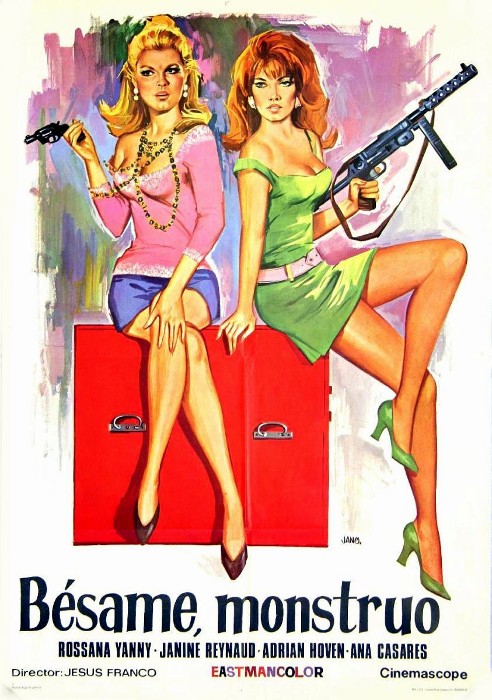
In those two films, our two femme fatales played detectives / cat-burglars in a Danger: Diabolik (1968) vein, where they help foil a couple of kidnapping plots as Franco piles on the eye-candy, kitschy decor, and swanky absurdity to such Herculean levels it's almost impossible to process it all. But, who cares! And by all means check them out!

Behind the camera, four sets of hands had their fingers in the plot-pot for this oddity. Along with an uncredited José Briz Méndez, who also directed, and Manuel Gómez Rivera, Robert Holt and Frank Gruber hammered out the script for White Comanche; a script that takes all the basic elements of your standard Spaghetti Western and systematically checks them off as the story progresses past each yard-stick.

I honestly thought Holt and Gruber were perhaps "American" names adopted by their Spanish counterparts to help it sell, but according to the IMDB the pair had a long and storied career writing for the old Boob-Tube.

And though director Méndez and cinematographer Francisco Fraile manage a few interesting setups, they become a little too obsessed with some trick mirror shots that were cool the first three times they used it but began to wear thin by the seventh or eighth refraction.

Adding even more surrealism to these proceedings is Jean Ledrut's plunky-guitar and horn-heavy soundtrack, which sounds like the interstitial muzak from some 1960s game show that was then cross-pollinated with a perky ditty from some vintage porn-loop. So, yeah, it doesn't fit the action or setting of White Comanche all that well.

But, you say, we're here for the Shatner, right? Right. As the ancient Hollywood proverb goes, "When you want somebody to play half-breed Comanche twins, you go for the Canadian Jew."

Yeah, well, truthfully, though he veers into full-blown Smarmy McSmarmo mode more often than not, where he brings the Grade-A ham and cheese something fierce, especially during the fight scenes, our boy actually manages to bring some gravitas to the role of Johnny Moon.

But as good as he was with that half of the equation, Shatner kinda screws the pooch with the other; as he portrays Notah with all the subtlety and nuance of a Whack-A-Mole game.

Part of the problem lies with the script, which calls for a climax where we can't keep track of which twin is which during the deadly duel, which, in turn, also calls for Notah to be clean-shaven, clean-cut, with the perfect Wild Bill wave of hair for all of his other scenes -- where, on top of all that hootin' and hollerin' and war-whoop'n, his evil sneer makes him look like, well, kind of an idiot.

I also think it's fair to warn potential viewers that even though a movie which promises and delivers William Shatner as belligerent half-breed Indian twins, White Comanche is not a whole can of lunacy from beginning to end. No. Not even close.

Expectation can be a bitch seldom satisfied, which is why, in the end, this film is a bit of a conundrum on the whole So Bad it's Good Scale. Sure, there are some blinding flashes of stupid to be found here; but in between those Notah interludes are a lot of dull stretches and soggy subplots to contend with and conquer.

Just remember: when a movie sounds too good to be true it usually is. Keep that in mind when you pop this into your DVD player or stream it, and you should be good to go.

Originally posted on July 8, 2010, at Micro-Brewed Reviews.

White Comanche (1968) Producciones Cinematográficas A.B. :: International Producers Corporation / EP: Vicente Gómez, Philip N. Krasne / P: Sam White / AP: Bruce Yorke / D: José Briz Méndez, Gilbert Kay / W: José Briz Méndez, Manuel Gómez Rivera, Frank Gruber, Robert I. Holt / C: Francisco Fraile / E: Javier Morán, Gaby Peñalba, Nicholas Wentworth / M: Jean Ledrut / S: William Shatner, Joseph Cotten, Rosanna Yanni, Perla Cristal, Luis Rivera

Sunday, December 4, 2022

The House that Screamed (1969)

"This is a boarding house, not a prison."

"Then I will make it a prison."

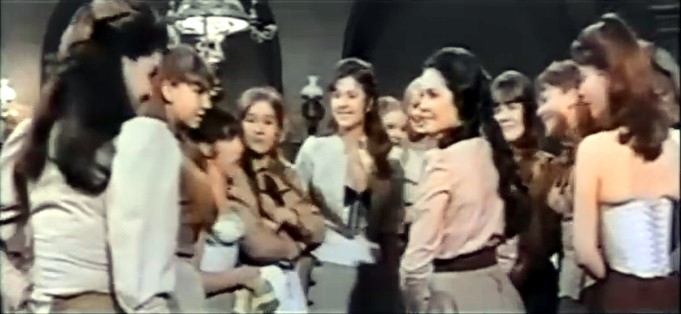
Our film begins in what appears to be late 19th Century France, where young Theresa Garan has just arrived at Madame Fourneau's palatial boarding school for girls (-- or, according to the horrible English dub that I first watched, Madame Porno's palatial boarding school for girls.)

Here, as the new ward is given the grand tour, it appears the establishment is a prim and proper finishing school, designed to train and prepare their students in the fine art of womanhood. But if this film teaches us anything, it's that things are never, ever what they appear to be.

See, turns out this school is the last resort for the wayward and the unwanted, and Madame Fourneau (Palmer) runs it like a Filipino prison camp. Those who show even the slightest signs of misbehavior or insolence are immediately placed in solitary confinement, where that insolence is then summarily beaten out of them with a leather strap.

Aided and abetted by a group of bullying trustees, led by the predatory Irene Tupan (Maude), they soon set their lascivious, sapphic sights on poor Theresa (Galbo); whom, it turns out, is the illegitimate daughter of a high-profile prostitute and some political muckety-muck, who is footing the bill to hide the girl away here.

But even before Theresa’s arrival, with all of those coming-of-age girls cooped-up inside these isolated academy walls, the tension and roiling sexual frustrations were already at critical mass -- even the sewing seminar carries an erotic charge. I'm serious. And to help defuse this pent-up hormonal powder-keg, Irene trades favors on the side for “access” to the local delivery man, leading to a romp in the hay in the adjoining stable for the lucky girl of the week.

Now, the only other men allowed on the grounds are a toady groundskeeper and Fourneau's adolescent son, Luis (Moulder-Brown). Kept on a short, incestuous leash by his mother, she forbids him to associate with these unworthy girls, wanting him to wait for someone more refined, like herself. But Luis still manages to sneak around the mansion's many hidey-holes and unused passages; especially around the showers, to play the Peeping Tom, which isn't as much of a show as you'd think since the uptight Fourneau won't even let her charges bathe without their smocks on.

The little pervert also arranges secret assignations with several of the girls -- girls who seem to go missing right after he promises to help them escape so they can run away together, he typed ominously.

Thus, over the last few months, about a half-dozen girls have up and disappeared under these very same and somewhat dubious circumstances, prompting the increasingly agitated and paranoid Fourneau to beef-up security even more to prevent any more of those ungrateful brats from, she assumes, running off. 

But then our first real clue that something far more sinister is going on presents itself. It begins with Isabella (Martin), Luis' latest doe-eyed conquest, sneaking off to meet him in the greenhouse; and then ends when she is brutally stabbed to death by some unseen assailant, as our movie drastically shifts exploitation gears from a delirium of forced sexual repression to maniacal mayhem and mass murder…

Let's be clear upfront: The House that Screamed (La Residencia, 1969) is one helluva disturbing movie. And awesome. Disturbingly awesome.

Another one of those Euro-Sleaze melting pots -- Spanish money and crew, shot in France, English and German actors -- the film just gets under your skin and itches like crazy. What it reminded me of most is a combination of Uncle Silas, author J.S. LeFanu's dark Victorian novel of mounting horror, and the visual, dreamlike ambiguity of Peter Weir's Picnic at Hanging Rock (1975), punctuated by explosions of graphic violence similar to Mario Bava in his Bay of Blood (Ecologia del delitto, 1971) phase.

To accomplish this, director Narciso Ibáñez Serrador, with a story assist from Juan Tébar, really over-stuffs the blender with all kinds of ingredients: a Gothic pot-boiler, a Women in Prison flick, and a seedy proto-Slasher, with some heavy gialli-like overtones to give the resulting slush a really surreal kick.

And Serrano plays the audience's expectations beautifully, capitalizing on an outstanding shooting location, beginning at the lowest speed, churning all of those elements together but they're still recognizable as they swirl around. But! As he ratchets things up, the plot (and the audience) is stirred, mixed, chopped, pureed, and finally, liquefied into something truly unique as we progress onward from that first murder.

For what really sets the film apart is how we keep switching perspectives, meaning just when we think we know what's going on, and who the main protagonist is, Serrador goes and bumps them off!

Remember how I said nothing is what it appears to be in this movie? Yeah, well, here we have the likable Theresa, set up perfectly as what would later be defined as the Final Girl, whom we expect to take us by the hand as the killer targets her as she unravels the unholy secrets of Fourneau's Academy. 

But as the Headmistress throws an even more draconian net over her unruly charges, and caught in Irene's ever tightening web of humiliation, Theresa wants nothing more but to escape this hellhole and turns to Luis for help.

Here, following form, we expect her to be attacked while trying said escape, resulting in a struggle, revealing the killer, etc. etc. etc. Well, she does attempt an escape but only makes it as far as the main hall before her throat is cut from ear to ear! Whoa. Well. So much for that Final Girl theory, right? Right.

Thus, since our heroine is now dead and we still don't know whodunit, the story shifts its focus to Irene, who is none too happy about her latest fixation flying the coop. Turns out she knew of Theresa's escape plan and was waiting in ambush outside the main entrance. But when her target never appears, all Irene finds is a splash of blood near the front door.

Quickly deducing that all of those missing girls are probably dead and buried somewhere around the campus grounds, Irene confronts Fourneau with this fact, who still doggedly insists the absent girls just ran off despite all evidence to the contrary. 

Irene, meanwhile, raises such a stink she loses all of her head trustee privileges. She’s even threatened with a trip to solitary and a whipping over her continued defiance until Irene reminds Herr Fourneau that she has enough dirt on her and how she runs things to ruin the school forever.

With that, the headmistress backs off, things disintegrate even further, and Irene decides she'd better get while the getting is still breathing. But when night falls, and Irene sneaks her way toward the main entrance, a strange voice draws the girl away from a sure escape and deeper into the darker recesses of the mansion, where the killer awaits. WARNING: Spoilers ahoy from here on out.

Thus and so, as we finally barrel toward the fantastically morbid conclusion of our ghastly tale, if you think Serrano is done pulling the carpet out from under you at this point, well, you'd be wrong. Dead wrong. Just ask Irene. No, wait. You can't. She's dead, too, leaving Madame Fourneau to find and face the inevitable truth -- the truth that puts the 'scream' in The House that Screamed.

For in the end, it's not so much as whodunit that's important but whyhedunit. He, you ask? Yeah, if the killer wasn't obvious enough all along, the final twist of why is an ample reward for those who sniffed out Luis as the culprit early, whose perversely innocent and ingrained motives to find someone just (-- stress on the JUST --) like dear old mom have finally reached fruition -- he just had to find her, one piece at a time.*bleaurgh*

Now, if you'd like to see The House that Screamed, which I hope this review will encourage you to do, there are several routes available. If it were me, I'd go after the Elvira's Movie Macabre double disc of this and Maneater of Hydra (La isla de la muerte, 1967), which still isn't ideal but was slightly better in quality than a YouTube rip -- I wouldn't be surprised if they both came from the same source. Shout Factory had it out on Bluray, and by their reputation I would assume they got their hands on a much better print, but I fear we all missed out on that one, which is now out of print and kinda expensive.

I initially watched this via an Amazon rental, which was marred by that aforementioned hatchet-job of an audio track. But I was hooked by the plot and visuals and later gave it another look on that Elvira DVD. For, despite those technical difficulties, I now consider The House that Screamed as one of my all time favorite Euro-Shockers and I look forward to finally seeing a decent print of it -- if it ever gets back into circulation.

Originally posted on May 8, 2011, at Micro-Brewed Reviews.

The House that Screamed (1969) Anabel Films :: American International Pictures / P: Arturo González / D: Narciso Ibáñez Serrador / W: Narciso Ibáñez Serrador, Juan Tébar / C: Manuel Berenguer / M: Waldo de los Ríos / S: Lilli Palmer, Cristina Galbó, John Moulder-Brown, Mary Maude, Maribel Martín